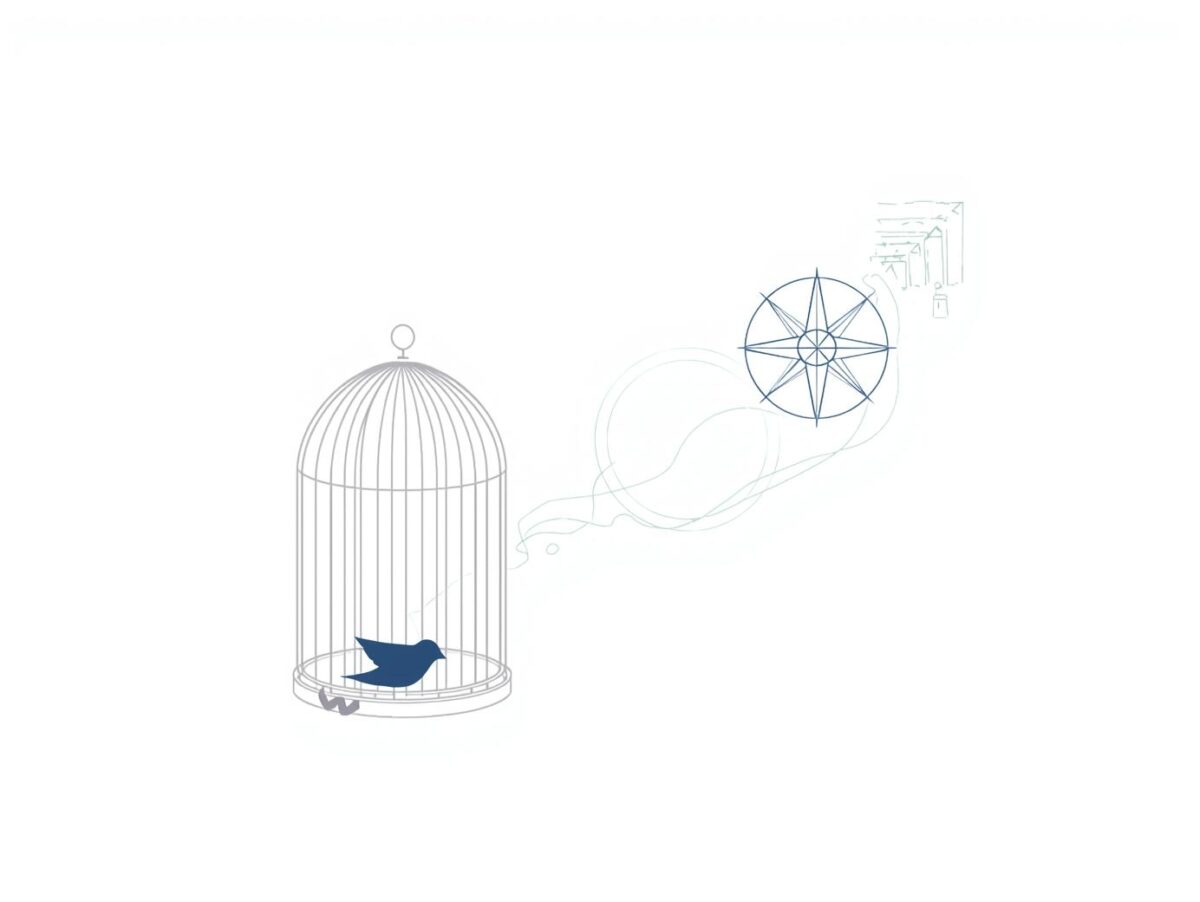
This article separates several forms of freedom — speech, time, money, and personal autonomy — and explains why a vague idea of freedom can become a new form of dependency.
Freedom is not a single block. Freedom of speech, financial freedom, time freedom, and personal autonomy are often mixed together even though they do not involve the same constraints or the same responsibilities.
This article puts these forms of freedom back in order so that a seductive but poorly defined ideal does not become a new dependency instead of a wider margin of choice.
1. Freedom of Speech: A Heritage We Too Quickly Forget
In our societies (in France, Europe, the United States…), we tend to consider freedom of speech as a given.
Yet, it is neither that recent nor that guaranteed.
Generations before us fought so that we could:
- talk about all subjects,
- criticize, debate, reflect,
- share our ideas with those around us, in public, on stage, live, on social media.
But freedom of speech ≠ saying everything that comes to mind without thinking.
True freedom of speech, for me, includes:
- an initial reflection,
- awareness of the impact of our words,
- the responsibility to not feed what destroys (hate, contempt, disrespect).
We can – and must – fight against what is bad…
But we can do so while staying aligned with one thing: the dignity of every person.
2. Money, Time, Happiness: Does More = Better?
We are often sold this shortcut:
More money + more free time = more happiness = more freedom.
I think this is partially true, but incomplete.
Yes, there is a minimum income that allows:
- to be more at ease with expenses,
- to take a bit better care of oneself,
- to have time for family, loved ones, passions,
- to better choose one’s living environment.
To give an idea (this is just an example, not an absolute truth):
- for a single person without dependents, having between €1,500 and €2,000 net per month can already provide a good margin to live decently (depending on cities, contexts, etc.).
But if for you, freedom means €10,000 per month and:
- you earn it honestly,
- with a clear mind,
- while staying aligned with your values…
Then congratulations: in this case, the real issue is to show others how you do it, rather than just displaying the result.
3. The Illusion of Total Independence
We see messages everywhere like:
“I want to be free, depend on no one, be totally independent.”
But… we live in an interdependent world.
Specifically:
- When you go out, you depend on the weather.
- When you eat, you depend on those who cultivated, transported, sold.
- When you work, even on your own, you depend on your clients, partners, suppliers, and the society around you.
Total independence does not exist.
What is possible, however, is:
- choosing who/what we depend on,
- building a healthy interdependence: balanced relationships, win-win collaborations, a team, a community.
Wanting to be totally independent, locked away in your corner, is not freedom.
Often, it is rather:
- an escape,
- a form of selfishness,
- being presumptuous,
- or sometimes falling into depression.
4. More Freedom = Less Security? Really?
We often hear:
“If you want more freedom, you have to accept less security.”
In personal development, it is explained that:
- security = comfort zone,
- stepping out of your comfort zone means taking risks, thus losing security.
I think this needs nuancing.
For me, security is not only:
- a permanent contract,
- a stable salary,
- a familiar environment.
True security is also:
- being in good health,
- having good relationships around you,
- being in an environment where you can grow,
- having a strong mindset.
And this can absolutely be strengthened while gaining more freedom.
More freedom and more security is possible:
- if you build a solid foundation (health, sleep, nutrition, exercise, good habits),
- if you develop your skills,
- if you surround yourself with the right people.
5. Working More to Be More Free? A Common Trap
Another classic:
“I’m going to become a micro-entrepreneur, work 16 to 18 hours a day, and I will be free.”
Let’s be honest:
- working 16–18 hours a day over the long term,
- even with €10,000 per month at stake,
is not a healthy definition of freedom.
Why? Because:
- without restorative sleep,
- without physical recovery (exercise, rest, breathing, time off),
- without a minimum of quality of life,
we end up emptying ourselves inside instead of freeing ourselves.
Paradoxically, those who truly succeed are not those who avoid effort…
But those who learn to:
- manage their energy,
- organize their time,
- prioritize,
- work smart, and often… in a team.
6. Working in a Team: Another Form of Freedom
We are often sold the myth of the “free solopreneur, alone against the world.”
But in reality:
- a balanced life,
- a lasting activity,
- a freedom that lasts over time,
are rarely built alone.
Freedom is also:
- knowing how to share tasks,
- distributing work more fairly,
- building a team organization where everyone contributes their part.
“It’s not: I have all my free time and my team does all the work for me.
True freedom is also being exemplary in what we ask of others.”
Leading a large team that lasts is not about dominating.
It is about:
- leading by example,
- aiming for excellence rather than immediate perfection,
- accepting that excellence requires work, effort, and organization.
7. The Sixth Sense and Freedom of Mind
We often talk about the “sixth sense”:
- in women, it’s called intuition,
- in men, it’s called instinct.
In reality, both – men and women – have both instinct and intuition.
But for me, the famous “sixth sense” is neither just:
- intuition,
- nor just instinct…
It is the mind.
The mind is a broader concept than the mental:
- the mental is the ability to think, project, analyze;
- the mind goes further: it allows us to give meaning, gain perspective, travel inwardly and beyond.
And here comes the central idea of this article:
Ultimate freedom is freedom of mind.
8. Freedom of Mind: The Highest Form of Freedom
You can be:
- rich,
- in good health,
- with a beautiful house,
- have a close-knit family,
- time for yourself…
And yet, not feel free.
Conversely, some people with modest means, a simple life,
can have immense inner freedom.
Freedom of mind is, for example:
- being able to see each day as a new day,
- not being trapped in one’s thoughts,
- learning to renew oneself,
- keeping a fresh perspective on oneself, others, and life,
- choosing where to put one’s attention, energy, anger, love, and time.
And that doesn’t just fall from the sky.
Freedom of Mind Requires Effort
To have more freedom of mind, you need to:
- work on yourself,
- keep making efforts, whatever your level,
- question yourself,
- nourish your mind with good ideas: reading, exchanges, communities, projects.
Even great thinkers, “scholars,” those who influence our society, continue to learn, work, doubt, and progress.
You too can create your future.
But it starts with a simple question:
What is MY definition of freedom?
9. Community, Collective Brain, and Growth
You can work on your freedom of mind alone,
but you can also rely on:
- a community,
- a group,
- a team with a “collective brain.”
A good community can:
- push us to think bigger,
- help us keep a free mind,
- support us when our motivation drops,
- inspire us to do better, to be better.
No matter:
- the time (even at 5 a.m.!),
- the time zone,
- where you live…
You can choose to be part of an environment that elevates your mind, instead of filling it with noise and distractions.
10. A Small Exercise to Finish
I suggest a simple exercise, inspired by the live session that gave rise to this text:
- Write your own definition of freedom.
Not the one from ads, not the one from social media, not the one from others. Yours. - Note:
- what represents more freedom for you,
- what represents less freedom for you.
- Ask yourself honestly: Does my current way of living, working, spending my time and energy align with that freedom?
- Choose one simple action, starting today, to get a little closer to your own freedom:
- say no to something that weighs on you,
- say yes to a healthier habit,
- cut out an unnecessary distraction,
- join a community more aligned with your values,
- take 20 minutes to reflect, write, meditate…
Conclusion: True Freedom Begins Within
To summarize:
- Freedom is not just about money, free time, or total independence.
- We live in an interdependent world.
- You can have more freedom AND more security if you build the right foundations around you.
- The highest form of freedom is freedom of mind.
And the good news is that:
No matter your current level, you can start working on your freedom level right now.
Have a great day,
and thank you for taking the time to reflect on your own freedom. ?✨
Reference: Freedom
Reference: artificial intelligence