I am talking here about starting from what is close to us, keeping a stable base in the face of current affairs, using artificial intelligence without letting it decide in our place, and staying responsible for our own lives.
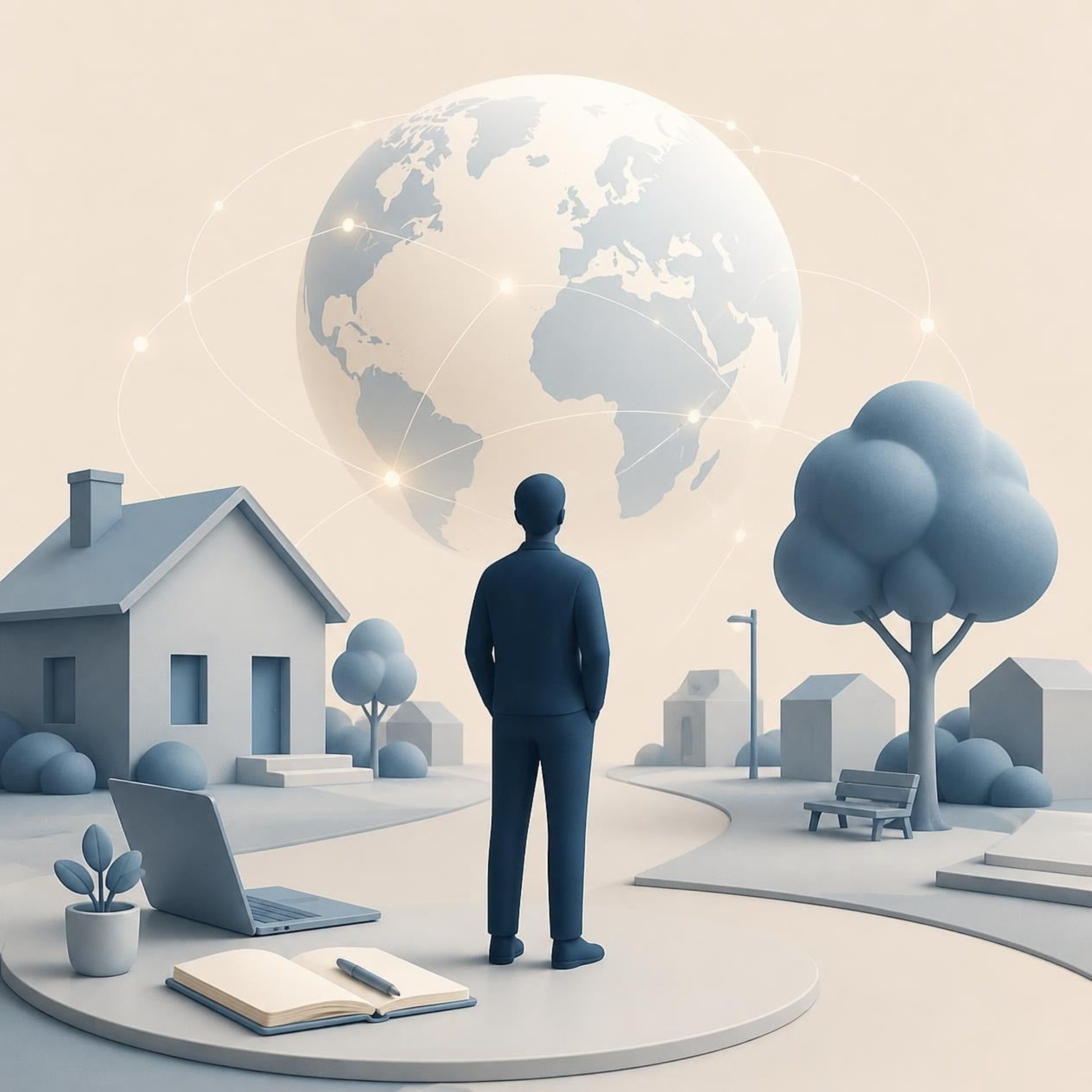
Think locally, reason globally
I am talking here about starting from what is close to us, keeping a stable base in the face of current affairs, using artificial intelligence without letting it decide in our place, and staying responsible for our own lives.
When I talk about thinking locally and reasoning globally, I’m not talking about a slogan. I’m talking about a way of living in a world in motion. We are often asked to react to everything, to understand everything straight away, to connect everything to everything else. I think we need to stay pragmatic. We need to look at what we live through, what we share with the people around us, and what we can truly influence. From there, we can open our view to the world without losing ourselves.
This is not an invitation to withdraw into yourself. It is an invitation to start from a precise place so that we can understand the whole more clearly. If we do not know what is happening around us, if we cannot keep a bit of stability in our own lives, then all the big talk about the world quickly becomes abstract. I prefer thinking that is rooted in reality. I prefer reflection that stays human, simple and tied to everyday life.
Start where you live
Think locally, reason globally, starts where we live, with the people around us, our neighbourhood, our family and our friends. When those closest to us are geographically close and we care for them, we are reasoning locally. We are looking after ourselves, our loved ones and our own affairs. That is not an abstract formula. It is a very concrete way of looking at the world from what we see every day.
Thinking locally does not mean closing your eyes to everything else. It means starting from what is real. It means looking at what is right around us before trying to embrace everything at once. We first live in a place, in a rhythm, in a daily routine. We share gestures, habits, responsibilities and sometimes worries. From there, we can think more broadly, with more calm and more precision.
I often think there is a misunderstanding around the word local. Some people imagine something small, almost limited. I see a solid base. Local is the place where you can check what you are doing, see what changes, and measure whether you are really moving forward. When you start there, you avoid getting lost in ideas that are too broad, too vague or too detached from everyday life.
The neighbourhood, the family, friends, the street and the district all matter. They seem modest on the surface, but that is often where the first decisions take shape. You can make grand statements about the whole world, but if you do not know how to act properly in your own life, everything becomes fuzzy. I prefer simple words grounded in things that can genuinely be lived and shared.
Keep a stable base
If we keep trying to understand everything on scales that are too large, we can change our mood for no reason, become completely unstable at every level. In the long run, we no longer know how to move forward. We react too quickly, we scatter ourselves, and we lose ground in our own lives. I think a lot of people feel that without always being able to define it clearly.
When you spend your time following alerts, shocking images, exaggerated reactions, conflicts and bad news, you end up losing the thread of your own reality. You let what is happening carry you along instead of choosing your own life. Personally, I prefer to keep a simple base. I look at selected news, then I come back to what I can do here and now, without thinking that I am at the centre of incomprehensible events.
Staying stable does not mean staying fixed. It means not letting every wave overwhelm you. It means keeping a centre. It also means accepting that you cannot deal with everything at once. You can listen, observe, think, and then come back to a more just action. That kind of stability is not boring at all. On the contrary, it helps you make better decisions, because you are not deciding under the sole pressure of the moment.
I think you need that breathing room through the day. We receive a lot of information. We see a lot of images. We hear a lot of things. But we must not let everything that passes through us take hold of us. Otherwise, we end up living in permanent nervousness. True balance is about accepting information without letting it take up all the space. That is what allows us to keep living normally afterwards.
AI helps, but it does not decide
Artificial intelligence also enters this reflection. It allows everyone to access information that was previously unknown to us. It speeds everything up. It is already changing the way we search, understand and work. I think we still underestimate how quickly it is changing our habits. What we once thought of as slow or complex suddenly becomes faster, more accessible and sometimes easier to put in place.
With enormous computing power, artificial intelligence is not officially able to answer everything. It can help, yes. It can shed light, yes. It can save time, yes. It does not replace judgement and the people who have to decide. Each of us carries that responsibility. AI alone does not know what is most right in a given situation, in a given family or in a given life context. That is where the ability to judge for ourselves remains indispensable for the choices we make in life.
I also see a question of privacy and responsibility. We can share information with artificial intelligence, but not in just any way. We cannot say, ‘I saw something today on television or on my smartphone, what should I do next?,’ as if the news or the media were going to decide for us. In reality, that makes no immediate sense. We need to keep that limit in mind, because it protects something very simple: our ability to choose for ourselves.
AI can suggest, classify, rephrase, speed up a search or help structure a thought. But it does not carry life for us. It does not know our relationships, our fragilities, our deeper aims, or the quality of our days. That is why I think we should use it as a tool, not as an authority. It is not a judge. It is not a moral guide. It is help, and nothing more.
I also think we need to be even more attentive at that point. The faster a tool is, the more we need to keep our course. The more it gives us access to answers, the more we need to check what we are really looking for. The present age pushes us to confuse speed with truth. Yet a quick answer is not automatically a good answer. That is another reason why I keep coming back to human responsibility.
What our choices produce
We need to avoid forcing links between every event. Not everything answers everything else automatically. Not all information and knowledge should become one big anxious blur. If we keep connecting everything, we end up seeing false causes and consequences, and losing the simplicity of everyday life. I think this confusion between current events and daily life is very strong today, because we have access to far too much information at once.
The choices and decisions we make every day have direct effects on our environment. Our actions, the way we reason, and the way we speak to other people all matter. If we do not keep that day-to-day rhythm, we fall into instability. We scatter ourselves. We lose the thread. It is often more discreet than a major upheaval, but it is exactly where life is built, or where it goes off course.
What I find important is that the world is not made only of big, often troubling news. It is also made of good news and ordinary people. The way we respond, the way we keep our word, a habit we repeat every day, an effort we repeat without making a spectacle of it: these are the things that really influence us and help us grow. These are the things that end up weighing on our surroundings, our mood and the quality of the relationships around us.
I also think people are quick to make the media or the news responsible for everything. But that is not how it works. We cannot put everything on the back of what we see on television. We also need to look at what we do with what we see. If we stay simple, clear-eyed and attentive, we understand better what depends on us and what does not.
In practice, that means learning to distinguish what depends on us from what is beyond us. We do not control everything. We do not decide everything. But we can decide how we look at things, how we react, and the energy we put into what we do. That is already a real lever, and it is often the one that changes the rest of the day.
Stay responsible for your own life
What I take away above all is that we have to stay responsible for our own lives. Everyone has their means, their capacities and their faculties. Artificial intelligence is only going to speed up that reality. Everyone will have to learn even more how to choose, sort and decide. That is probably where the real work begins, because it is no longer enough to wait for an outside solution to come and solve the problem for us.
Being responsible does not mean putting unnecessary pressure on yourself. It means recognising that you have a share in steering your own life. Of course, we do not control everything. There are constraints, limits and sometimes difficult contexts. But there is always something to do with what we have. We can think, organise, correct, adjust, take a more just direction and learn how to hold that direction over time.
We also need to agree on how things should be done, and above all to take responsibility. Serious events and trivial events alike: we have already seen them in one form or another twenty, forty, sixty or eighty years ago. The forms change, but the big questions come back. We change the scenery, but not always the problem. That repetition can be discouraging, but it can also teach us to stay clear-headed.
I like that idea because it stops us from thinking we are at the centre of everything, but it also stops us from feeling powerless. It puts us back in our proper place. It tells us that life is not a theatre where we wait passively for everything to sort itself out. It asks us to take part, even modestly, in what is around us. And it is often in that regular participation that we find a bit of strength and clarity again.
AI can speed things up, but it does not replace decision-making. It does not replace patience either. And in a human life, patience matters enormously. Sometimes it takes time to understand what we are living through, to accept what we cannot change, and to make better choices afterwards. Responsibility, at root, is also the ability to take the time to see more clearly.
The concrete world of relationships
And despite all that, there are also very simple things that matter: the pleasure of meeting again after months or years, reconnecting, talking again, giving a direction back to what we are living through. These are modest moments, but they carry a lot of weight in a life. They remind us that we are not only spectators. We are also people who connect, repair and take our place again in our own story.
I think those reunions say something fundamental. They show that life is not only made up of big systems, big strategies or big ideas. It also unfolds in a renewed connection, in words found again, in a simple gesture, in a message sent at the right moment. We sometimes forget those things because they do not make any noise, but they have a real power to reorient things.
When you take the time to speak to someone again, you often realise that many imagined tensions were smaller than you thought. Sometimes all it takes is one exchange to let a little air back in where everything seemed closed. That is also what thinking locally means: taking real people into account, concrete relationships, and links that we can still maintain or rebuild. The world begins there, in that ability to go back to others simply and openly.
The pleasure of seeing each other again after years should not be treated as a footnote. It is often a sign that time has passed, that things have changed, but that there is still room to meet again. And in that space, we can start living differently once more. We can apologise, explain, listen, understand and move forward. I think that is a quiet strength, but a very important one, in an age that values speed above almost everything else.
Think big without leaving the practical behind
Destiny can change. Meditation, the choices we make, the decisions we take, our actions, our words, our state of mind: all of this plays a part in the way we evolve, including on a spiritual level. We are not condemned to remain in a situation with fatalism. We move forward, we act, we learn, and we change our attitude towards what we thought was already settled or unchangeable. I think that idea matters because it stops us reducing a life to where it began or to its present reality.
I am not saying that everything is easy. I am simply saying that there is room for movement. Even when it feels as though everything has already been decided, there is often still a space to act, to think differently, to take another path. That is where personal responsibility meets inner freedom. We do not always choose the circumstances, but we can often choose the way we live within them and the way we respond to them.
What I like about this idea is that it avoids the extremes. If we only look at what is around us, we can end up closing in on ourselves. If we only look at the whole world, we can end up floating. In both cases, we lose something important. I try to hold both together: the close and the vast, the home and the world, the daily gesture and the broader vision.
In the end, it is often the small things that matter most: habits, repeated decisions, the way we care for what is in front of us, the way we speak to other people, and the way we organise ourselves every day. It is not spectacular, but it is what lasts. It is also what keeps us from getting lost in the noise of the world while still remaining open to what is happening elsewhere.
That is why I find this idea useful. It does not ask us to carry everything. It does not ask us to close our eyes either. It invites us instead to keep a clear, human and stable position. It helps us keep our course when everything around us is moving quickly, when the discourse speeds up, and when tools promise immediate answers. It reminds us that first we have to stay alive, present and attentive.
What I keep in mind day to day
At heart, what I keep in mind is this: you do not need to understand everything in order to act. You do not need to follow everything all the time either. Often, it is enough to keep one simple line: see what concerns me, distinguish what helps me from what hurts me. That discipline may seem modest, but it stops you from being overwhelmed by over-information. It also helps you find clarity again when ideas start to overlap.
So I choose the information I consult and study. I look at what really deserves my attention, then I go back to my day, my work, my loved ones and my surroundings. I prefer to learn how to filter what inspires me, without forgetting our social problems. That does not mean keeping my distance. It means staying available without suffering everything. It is a small distinction, but it changes a great deal in the way we keep our course.
With artificial intelligence, it is the same story. I can use it to save time, to rephrase, to search, to compare. But I do not want to hand over my place in the decision-making process. I want to keep the use, not abandon it or get lost in it. I want to keep the tool, not the authority or the excess. That limit matters because it protects reflection, evaluation and quality of life. It reminds me that I remain responsible for what I choose to do with my own capacities.
I also pay steady attention to the people around me. When you live locally, you can see more clearly what really matters: the way we speak, the way we listen, the care we give to other people, the stability we bring or remove. The wider world is never completely abstract. It often begins in a relationship, in a conversation, in a gesture that restores a little order or a little trust.
That is why I keep coming back to the same idea: thinking locally means acting fairly where you are; reasoning globally means keeping a broader view without losing your grip. If I keep those two things together, I feel more at home. I can move forward without scattering myself, stay open without getting lost, and look for a better life without forgetting the rest of the world.
I also think we need to accept one thing: not everything deserves the same level of intensity. Some information calls for real reflection. Other things can simply be noted, then put away without us pouring all our energy into them. That is a way of protecting our concentration and our availability. If I want to remain useful, I also need to remain available to what is real around me. I cannot let every topic of the day drain me.
And that is probably where the idea of reasoning globally really comes into its own. Thinking big does not mean absorbing everything. It means keeping a broad enough view to understand that my gestures have a reach, but a stable enough one to keep acting locally. I can follow the world, but I also have to live my day. I can step back and think, but I also have to speak to the people around me. It is in that balance that I find a form of harmony.
Conclusion
If I summarise it simply, I would say this: thinking locally means starting from the concrete. Reasoning globally means thinking bigger. And between the two, there is a way of living in this world that must stay simple, open to everyone and balanced.
It is a more balanced way of living. I look after what is close to me, I stay attentive to the world, and I do not forget that what I do here can have an echo further away. By trying to do well ourselves and to make sure that other people do well too, we can move towards a better life, which is possible.
In my view, thinking locally and reasoning globally is about making sure that ourselves, and the rest of the world, are happy as much as possible and know happiness. I think about local happiness and I wish the rest of the world happiness.
I think that is a beautiful conclusion.