The infinitely large, the infinitely small and fractals
From fractals to the universe, a personal reflection on the links between the infinitely large, the infinitely small, artificial intelligence and the limits of our knowledge.
The infinitely large, the infinitely small and fractals: how far can we understand our universe?
So, the infinitely large, the infinitely small, quantum physics and fractals.
This is a subject that can seem extraordinarily broad. That is precisely what interests me about fractals: they allow us to reflect on both the immense and the minute, on what we know and on everything that still escapes us.
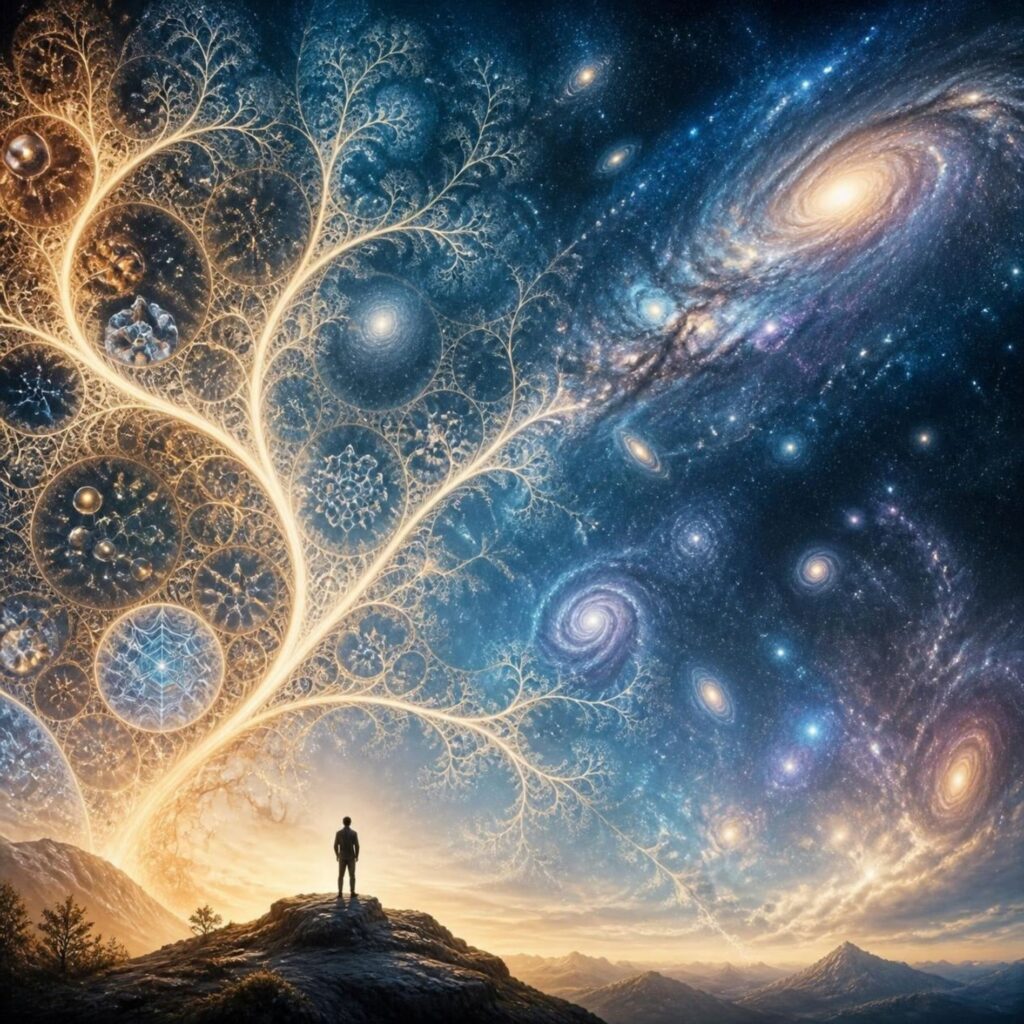
Fractals are beautiful mathematical objects. They can produce magnificent geometric forms and resemble structures found in reality: crystals, the branches of a tree and other natural shapes.
What fascinates me most is the idea that a fractal is both something known and something unknown.
When you explore a fractal graphically, you do not necessarily know which path you will take. Yet, after a while, you find a pattern resembling one you have already encountered.
And you can keep zooming in.
Again.
And again.
With the impression that the pattern could continue repeating.
I find these mathematical objects truly fascinating, even though the precise formulae are beyond me today. They remind me in particular of my mathematics studies, with exponentials, complex numbers and a whole collection of concepts that I no longer use every day.
But the forms they produce remain magnificent.
From seed to tree: finding the same structures
Let us take something much more concrete: a tree.
At the beginning, you have a seed.
That seed will grow for years to become a tree, and the tree will in turn be able to produce more seeds.
Across the lifespan of a tree, which can reach a hundred years or become far older in some species, we find cycles.
There are also the cycles of the seasons.
Biological cycles.
The cycles of our own lives.
Even our calendar is built around cycles: every year, we return to 1 January.
Of course, a calendar is a human convention, while a fractal goes much further.
But the idea that interests me is the repetition of certain patterns at different scales.
The branches of a tree provide a particularly interesting image of this.
At another scale, we can look at much larger structures, such as those of the universe, or at extremely small structures, such as molecules and certain details of living organisms.
Finding the infinitely large in the infinitely small
This is where the reflection becomes interesting.
In a fractal representation, we can zoom in enormously while continuing to find forms that resemble what we observed at a larger scale.
So we can naturally ask a question:
Is there a relationship between the infinitely large and the infinitely small?
Could some structures observed in our universe follow principles that also appear at minute scales?
I am obviously not claiming to possess a mathematical formula capable of describing the universe.
But the question itself is fascinating.
And it immediately leads to another:
Could our universe itself be described by an extraordinarily complex function that we do not know?
Could our universe be a kind of fractal?
We can imagine a great many things.
Some theories and works of science fiction go so far as to present our universe as a kind of computer program.
Our lives would then be programmed.
Our paths would be predetermined.
Somewhere, there would be a function complex enough to describe what happens.
Personally, that is not what I believe.
I believe that mathematics has its limits, just as every scientific field has its limits.
A fractal follows parameters.
It exists within a precise mathematical context.
Observing that a mathematical object can produce infinite patterns therefore does not automatically mean that our entire lives are determined by one gigantic equation.
But that does not prevent us from asking the question.
We can certainly discuss these theories without immediately dismissing them as absurd, while making clear that they are not necessarily our own convictions.
The limits of our knowledge
The further we seek the limits of the infinitely large, the more we encounter the unknown.
And the further we seek the limits of the infinitely small, the more we encounter the unknown there as well.
Ultimately, we return to the same problem.
What lies beyond what we can observe?
Is our universe finite?
Is it infinite?
And if we descend towards the infinitely small, is there a final limit?
After molecules, atoms and subatomic structures, how far can we go?
At some point, we inevitably reach what we cannot yet explain.
I believe it is important to know how to acknowledge that boundary.
Science also has a history and a culture
When we look at the history of science, we find people with remarkably broad learning.
Mathematicians also studied literature, Latin, Greek and philosophy.
Scientific exchanges once took place in languages other than those used today.
Latin long held an important place in the transmission of knowledge in Europe. French also had considerable international influence in certain circles.
Today, English very clearly dominates a large share of scientific and technological exchange.
Now, with artificial intelligence, we are seeing a great many new terms, concepts and ways of learning appear.
AI makes it easier to approach subjects that we do not initially understand.
But here again, it does not automatically transform the unknown into something perfectly known.
Can artificial intelligence answer the great questions?
We can ask an artificial intelligence a great many things.
We can ask it to explain fractals.
Quantum physics.
The history of mathematics.
Different theories about the universe.
It can suggest avenues to explore.
It can compare ideas.
It can help us discover vocabulary and concepts.
But will it choose our view of the world for us?
I do not think so.
The more we use artificial intelligence, the more we also depend on computer systems for part of our access to information.
But that does not mean we should stop thinking.
Quite the opposite.
Even if artificial intelligence can show us different paths, we are still the ones who must make choices and decisions.
I do not believe in absolute independence
This is where I connect the subject to another idea that interests me: interdependence.
We talk a great deal about independence.
A professional can be “independent” or self-employed.
In English, we also use the word freelancer.
But are they truly independent?
They depend on their clients.
They depend on their budget.
They depend on their tools.
They depend on their economic environment.
They depend on the people with whom they work.
Complete independence does not really exist.
We were not born alone.
We do not live alone.
We live in society.
For me, it is therefore far more coherent to speak of interdependence.
More freedom does not mean fewer constraints
We may want to be completely free.
To choose whom we speak to.
How much we earn.
Where we live.
With whom we spend our time.
To decide absolutely everything for ourselves.
But the more we seek absolute freedom and absolute independence, the more we may encounter new obstacles.
That is because we live in a reality with its own rules and constraints.
At the other extreme, total dependence would make no more sense.
Saying:
“A future artificial superintelligence will think for me, and I will no longer need to make decisions”
would, in my view, be the opposite excess.
We must continue to think about our lives, our obstacles, our choices and the path we wish to follow.
Personal development and the idea that our thoughts control everything
Some approaches to personal development sometimes suggest that every word, every sentence, every action or every thought could completely shape our own universe.
Personally, I find this view too self-centred.
Taken to an extreme, I even think it can become narcissistic.
Our small egos do not control the entire universe.
Of course our decisions have an influence.
We can act upon our environment.
Upon our relationships.
Upon our family.
Upon certain aspects of our situation.
We can choose a direction and try to build a life that makes us happier and more fulfilled.
But we are not alone.
And not everything depends solely on our thoughts.
Finding a reasonable path
This brings me back to something that appears very often in my reflections: balance.
When we are young, we may seek pleasure.
We may go to excess.
We may also fall into different forms of dependence.
I have experienced excesses and failures myself.
But even something considered positive can become harmful when it becomes excessive.
Exercise is positive.
Exercising to a completely excessive degree can become problematic.
Wanting to progress is positive.
Wanting to accelerate absolutely everything can also cause problems.
For me, therefore, a sound path begins with something quite simple:
being reasonable.
A tree does not grow in a day
And we return to our tree.
A tree may take twenty years to become magnificent.
You can observe it every day without really seeing it grow.
But come back a year later.
Then two years later.
Then ten years later.
The change becomes obvious.
It blossoms with the seasons.
It develops through cycles.
I find this image interesting because it also allows us to reflect on our own development.
We sometimes want to see results immediately.
But some transformations need time.
Fractals as a gateway to curiosity
I am not part of a laboratory or a consortium of scientists specialising in the study of fractals.
I therefore do not claim to understand all their scientific applications.
What I can tell you, however, is that these objects are very easy to discover.
Simply look for images of fractals.
Or videos that let you zoom into fractals.
You will generally see magnificent structures that seem to continue as you move closer.
They immediately make you want to reflect on the infinitely large and the infinitely small.
Stars in the universe… and in our vocabulary
There is another image that amuses me.
We speak of a star in the sky.
But a star can also be a famous person.
In dance, we also speak of star dancers or principal dancers.
Why do we use the same image?
A star shines.
It attracts our attention.
But did a star “decide” to shine more brightly than the others?
Did it make a greater effort?
Phrased like that, the question obviously becomes almost philosophical.
A star formed through processes beyond its control.
Once again, this allows us to reflect on the difference between what we choose and the conditions in which we exist.
Every culture has looked towards the sky
Human beings have been observing the heavens for a very long time.
The Sun.
The Moon.
The planets.
The stars.
Different civilisations have created myths, representations and symbolic systems around what they observed.
We find such representations in a great many cultures.
I do not claim to know each of them precisely.
What interests me is this human constant: trying to understand our place within something far greater than ourselves.
We do not each live on our own planet
We sometimes hear expressions such as:
“I live in my own universe.”
Or:
“I am on another planet.”
They are figures of speech.
In reality, however, we all live on the same planet Earth.
We share a common world.
And this immediately brings us back to interdependence.
Some populations face poverty.
Illness.
War.
Extremely difficult circumstances.
People working for humanitarian or charitable organisations may take considerable risks to help people they did not previously know.
Some return deeply affected by what they have seen.
This inevitably creates a contrast with everyday life in other parts of the world.
Globalisation: seeing wealth and poverty at the same time
Globalisation and technology bring us into far more direct contact with these differences.
We can see wealth.
And a few seconds later, we can see extreme poverty on the other side of the world.
This inevitably produces a shock.
But I also believe we must be careful about how we view reality.
If we focus exclusively on everything that is going wrong, we end up believing that nothing ever improves.
Personally, I prefer to look at problems without forgetting to look at what is also improving.
Do the media show too much of what is going wrong?
I have already discussed this question several times.
The media naturally tend to discuss what attracts our attention.
Scandals.
Conflicts.
Disasters.
Shocking situations.
But if we consume only this kind of information, what view of the world do we ultimately build?
We may feel like no longer thinking.
Like staying on the sofa.
Like watching series or films simply to forget everything else.
Is that wrong?
Not necessarily.
Watching a good programme, relaxing and enjoying some entertainment can perfectly well form part of a balanced life.
But, as always, the question of excess returns.
If the sole aim becomes to avoid thinking about anything all the time, I am not certain that this truly allows us to flourish.
To return to fractals…
This is a good illustration of how I think: I begin with fractals and arrive at the media, society, interdependence and happiness.
So let us return to our original subject.
For me, fractals first demonstrate a mathematical beauty.
Personally, I do not know many fractals that I find ugly.
They also allow us to imagine relationships between different scales.
The infinitely large.
The infinitely small.
Repetition.
Cycles.
Structures.
The unknown.
That is already an enormous gateway into other fields of knowledge.
Quantum computing, AI and results we do not always understand
We can also draw a connection with modern computing.
Today, we speak of quantum computing, involving systems whose actual operation is extraordinarily complex for someone who is not a specialist in the field.
With artificial intelligence, we sometimes encounter something comparable in our relationship with the tool.
We do not necessarily understand in detail everything that happens inside the system.
We do, however, observe the results.
We work with those results.
We evaluate them.
We correct them.
When they suit our needs, they can bring something valuable to a great many fields:
health,
culture,
education,
knowledge,
communication,
and many other areas.
Can we find a universe within an image?
A photograph can already contain a great deal of information.
A video can contain even more.
When we begin analysing the information contained in images, texts, sounds or videos, we discover levels of detail that we do not necessarily see straight away.
In its own way, this once again brings us back to the idea of zooming in.
Observing something.
Then looking more closely.
Then closer still.
And discovering new structures.
What if our universe were finite?
We then reach one final question.
If our universe is finite, what lies beyond it?
Some people speak of a multiverse.
We could then imagine an infinite number of finite universes, each with its own cycles of birth, growth, transformation and perhaps disappearance.
Personally, I remain attached to the idea of an infinite universe.
But if someone wants to explain to me that our observable universe is finite, another question immediately arises:
what lies beyond it?
Once again, we encounter the unknown.
It is exactly the same difficulty we face when descending towards the subatomic scale and asking:
what is smaller still?
In both directions, we eventually reach the limits of what we know today.
Accepting that we do not know everything
Ultimately, perhaps this is what I find most interesting about this reflection.
Fractals allow us to reflect on a great many different subjects, but they also remind us of something very simple:
our knowledge has limits.
We can study.
We can use mathematics.
Physics.
Computing.
Artificial intelligence.
We can compare different theories.
But there will probably always be something left to discover.
That is precisely what makes research and knowledge so fascinating.
I will therefore stop here after a discussion in which I have indeed covered a wide variety of subjects, all starting from a rather unusual mathematical object.
If you have fifteen minutes to spare, simply ask an artificial intelligence to explain fractals to you, then look at a few graphical representations.
You will see.
It is fascinating.José DUTIAN
Between discipline and improvisation, organization and freedom, this article explores how to find personal balance in a world shaped by AI, social media, digital work and…
Artificial intelligence is changing education, culture, social relationships and the future of young people. A reflection on learning, critical thinking and relationships.
I am talking here about starting from what is close to us, keeping a stable base in the face of current affairs, using artificial intelligence without…