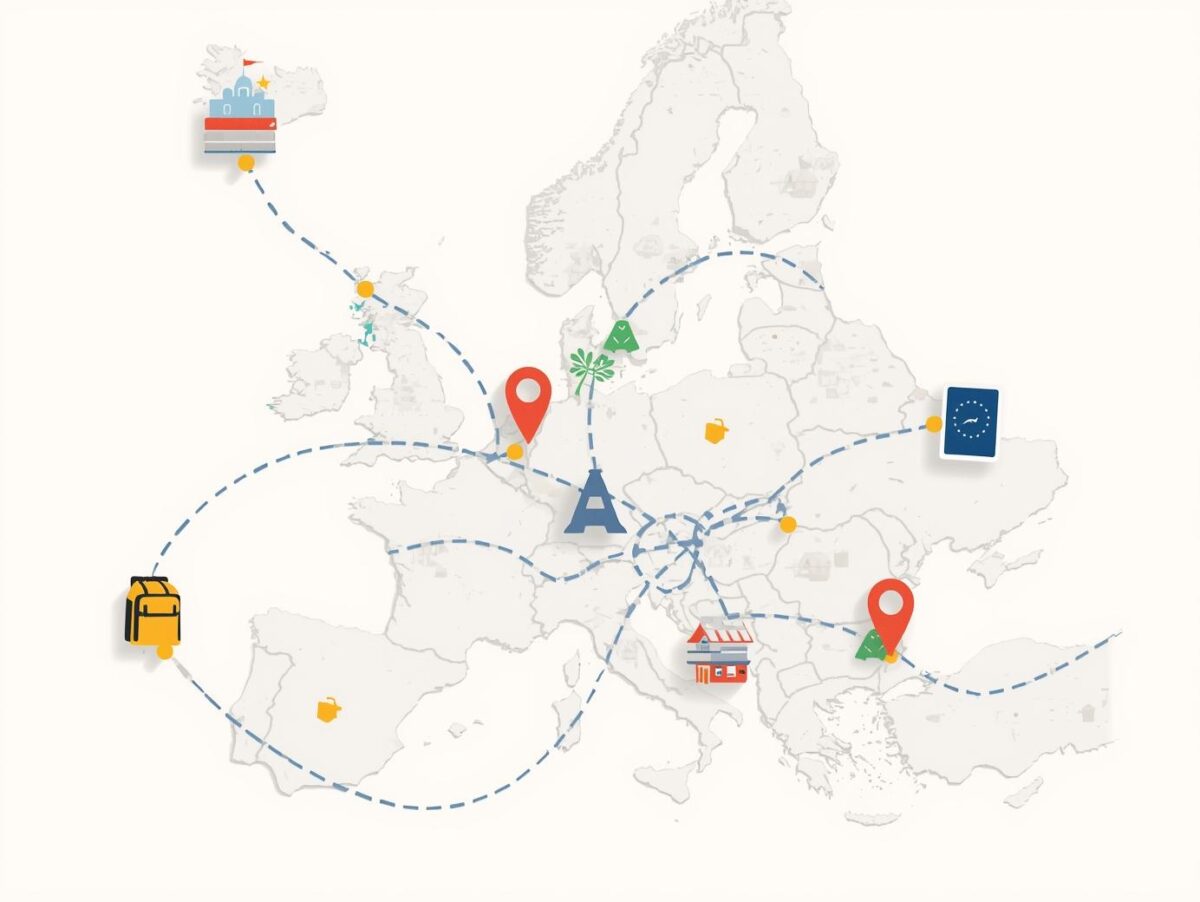
Traveling in Europe before 35 does not require a huge budget or a complicated plan. This article shows how trains, cultural proximity, and European mobility can become an accessible and educational adventure.
AI Mention: Article created by the author from recordings, structured by AI, reviewed and corrected by the author, then voiced by AI.
Traveling in Europe before 35 does not require a huge budget or a complicated plan. With train travel, nearby countries, and European mobility, the adventure is often more accessible than people assume.
This article treats travel as both a concrete and educational experience: discovering neighboring cultures, realizing that the world is small, and understanding how moving early can reshape a personal path.
The Trigger: Understanding That “The World Is Small”
You don’t even need to go to Paris to feel that the world is small… but a large cosmopolitan city (Paris, or other European capitals) accelerates this awareness.
On public transport, in an hour, you can encounter 10, 20, sometimes 30 nationalities. And when you have the chance to travel outside Europe as well, this feeling is even stronger: the world is more connected than we imagine.
The Starting Point: A Budget, Even Small, But Thoughtful
Traveling requires a minimum budget, especially if you’re starting from “wealthy” countries (France, Belgium, Netherlands, Germany, Switzerland, Austria…). Leaving this zone costs something, but once elsewhere, the economic logic can change.
My reasoning at the time (about 20 years ago) was simple:
- I set myself a budget.
- I want to travel for a long time.
- So I aim for countries where life is more affordable, notably Eastern Europe.
Of course, you can also travel in Spain, Italy, Portugal, “go south,” enjoy milder temperatures, especially in winter. But if your goal is to maximize duration with a limited budget, the East has often been a very interesting option.
The Minimal Traveler’s Kit: Simple and Effective
The idea is not to leave with heavy logistics. On the contrary:
- a good pair of sneakers
- a bag (or backpack)
- well-managed savings
And then, you build as you go.
The Secret Before 35: Youth Hostels
If you are under 35, there is an obvious lever: youth hostels, often affiliated with a network (a federation of youth hostels, at least on a European scale, and probably broader).
Why it’s an excellent choice:
- you sleep in dormitories or sometimes in rooms (depending on the place)
- you meet travelers of all nationalities
- sometimes breakfast is included
- you create a “small world” of travelers: you meet again from one city to another, it becomes a kind of temporary family
- you can visit as a tourist… or even look for work if that’s your plan
It’s a very coherent solution when you want to travel without blowing your budget.
Transport: Train, Bus… and the “Sporty” Option
1) Train and Passes
At the time, I had checked with SNCF and other companies: there were forms of passes or European solutions to travel unlimited by train monthly. Today, you no longer need “complicated protocols”: there has been a clear evolution of options and prices (depending on periods and countries).
2) Bus: Leaving France for €150–200
From what I recall, leaving France by bus could be done around €150, sometimes €200 depending on your location (if you are very far west, for example). And now, there are very accessible European bus networks. They suffered during Covid (two years without travel), but the idea remains: the bus can be an economical solution.
And there’s also a personal argument: if you want to avoid polluting more, you can prefer bus/train over flying.
3) Bicycle or Walking: The Extreme Challenge
For the more athletic: some even do the tour of Europe by bike, or a tour of the external borders, or significant portions on foot. It’s another level, with real logistics (changing clothes, sleeping, eating), but it’s possible and it exists.
My Sample Itinerary: Paris → Munich → Prague… and the Price Shock
In my case, I started quite simply:
- walking from my home
- then train to Paris
- then Munich
- then Prague
And then, the trigger: everything was much cheaper.
I realized that in a few days (4–5 days), between transport and hostels, I had already spent a large part of my monthly budget. And as soon as I arrived in Prague, I understood that the trip could last much longer, because life cost about three times less (that was my feeling at the time).
Examples of benchmarks I had in mind:
- Munich: €24 per night in a youth hostel
- further East: €8 per night in a hostel (in some cities/countries)
- and even long-distance train trips at very low prices (sometimes the equivalent of less than €10, e.g., Prague – Warsaw)
Result: instead of shortening the trip, I wanted to stay longer in countries where the economy was different.
Language: English Helps, and Today Translation Saves You
In hostels and while traveling, speaking at least some English helps a lot.
And if that’s not your strong point: today, you can use translation tools (including voice) on your smartphone. You record, it translates, and you can communicate more easily with correct vocabulary in the local language.
Culture: Museums, Cities… and Even Cinema
Traveling in Europe is also:
- historical remains
- magnificent churches
- thermal baths in Hungary
- The Bratislava Castle
- museums
- a rich and varied Europe
- …
Even simple experiences like going to the cinema teach you things: I expected to be “lost” without the language, but I very often came across American films, sometimes dubbed, often in the original version with subtitles in the country’s language.
It made me realize the American cultural influence, including in Europe, and also a reality: subtitles don’t translate word for word, so learning a language “just with movies” isn’t so simple (it’s nothing like current language apps).
Traveling Easily: Schengen and the Simplicity of Borders
I also had in mind a very practical point: the Schengen area. With a French ID card (or depending on your nationality/conditions), you can travel in a large part of Europe without heavy procedures. Otherwise, a passport will do.
Once again, you realize that the world is small, both in a big city and in Europe.
And the Future: A “European Metro” (Long-Term Vision)
There is also a vision/project mentioned: the idea of a very high-speed rail network even more integrated, a kind of “European metro,” where you could change countries almost like changing stations in a big city. It’s a future project and will take time, but the idea is there: to make train travel even smoother and more accessible.
Conclusion: Travel Light, Travel to Meet, Travel to Understand
If you are under 35 and want to travel:
- travel light (sneakers + bag)
- plan a budget to “leave” expensive countries
- use youth hostels
- aim for more affordable areas if you want to travel longer
- accept encounters: they make up a huge part of the trip
- open yourself to European culture… and you’ll see the world is much smaller than you’ve been told
Best regards,
José D.
Reference: Traveling Europe
Reference: computer science
Reference: artificial intelligence