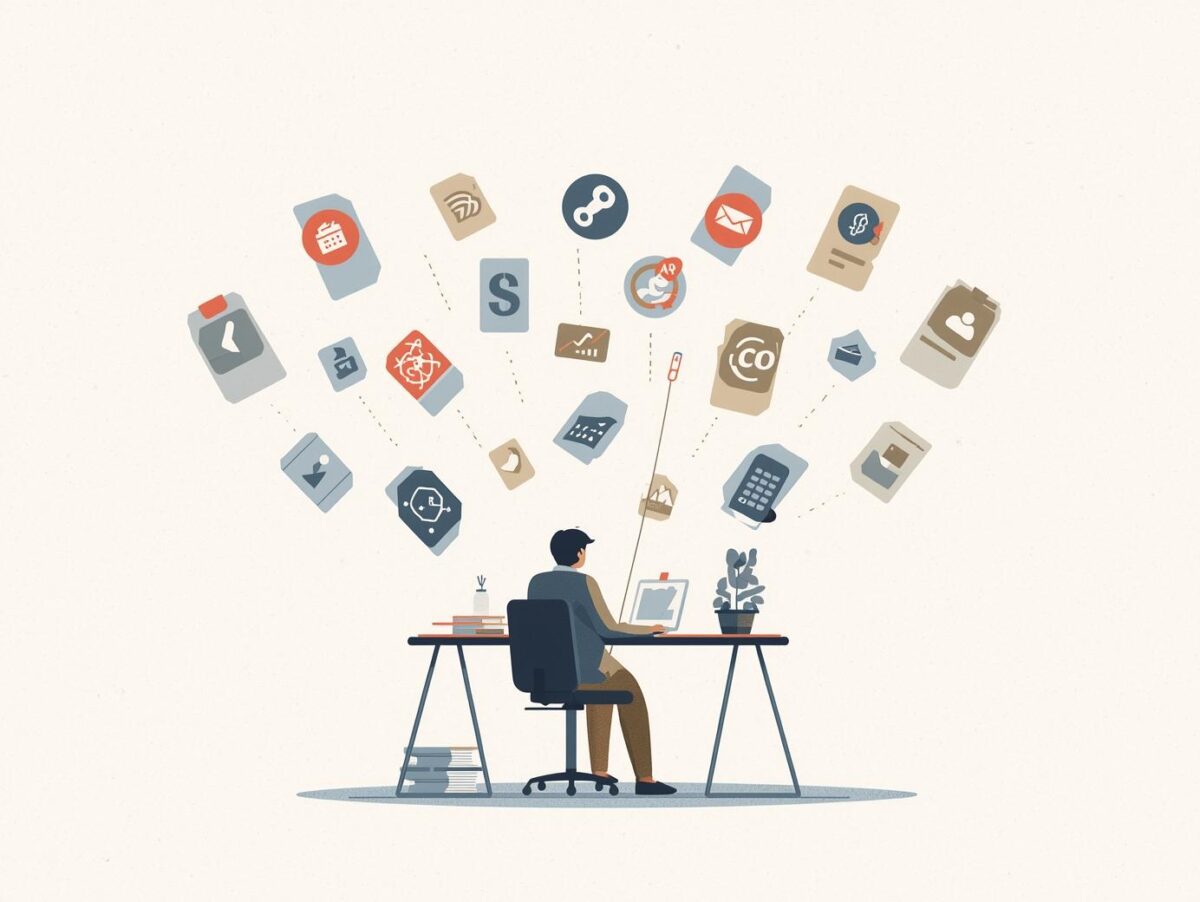
The real problems faced by self-employed people in 2026 are not only about clients or motivation, but about too many options, scattered attention, and weak prioritization. This article shows how computers, phones, artificial intelligence, and strategic focus are reshaping independent work.
AI Mention: Article created by the author from recordings, structured by AI, reviewed and corrected by the author, then voiced by AI.
The real problems faced by self-employed people in 2026 are not only about finding clients. They often come from too many options, scattered attention across screens and tasks, and a fragile sense of focus.
This article takes a practical angle: computers, phones, artificial intelligence, visibility, priorities, and working rhythm. The real challenge is not doing more, but recovering a clear strategic direction.
The acceleration: doing in 3 weeks what used to take 6 months
If you don’t start with overly complicated projects, artificial intelligence makes it possible to produce results on a daily basis.
And when you know how to organize yourself over 15 days or 3 weeks, you can do the equivalent of 6 months of work… compared to your previous skill level.
Things are accelerating thanks to AI.
But at the same time, there is still a lot of uncertainty around this technology: how we will use it, its effects, the choices to make.
The main problem: the variety of tools and options
If we come back to the topic of the problems faced by self-employed people today, there is one central issue: the variety of tools, the variety of options.
When you have a computer and a phone connected to the internet, you find yourself facing a vast list of tasks:
actions linked to the opportunities you have committed to,
ideas, projects, desires,
the desire to grow within an activity.
And then we come back to an expression that was used a lot a few years ago, and that we hear less today: staying “focused.”
“Staying focused”: a real challenge when you go in every direction
Staying focused means concentrating on one project.
And that is precisely one of the major problems: jumping into 50 ideas in a conversation and then getting nowhere. Or failing to finalize anything at the level of:
a discussion,
a potential partnership,
a project,
or even an already existing activity… that is not flourishing.
Whereas if we were truly focused on our projects, without branching off into other directions as self-employed people, we would get there much more easily.
Another obstacle: the basic level of IT knowledge is often low
Why does this point come up so often among self-employed people?
Because the basic level of IT knowledge, in general, is not very high. And everything technical can seem complicated—and that is normal.
In principle, IT is supposed to be easy to use and save time on communication, rather than spending your life:
on the phone,
on emails,
or managing technical details.
IT is meant to support communication, both personal and professional.
And that is precisely why platforms like Facebook, Instagram, YouTube, etc. thrive: thanks to communication… and paid and organic advertising.
AI demonstrations with no vision: a lot of noise, little meaning
What we often see are people who already have money and who demonstrate what they can do with artificial intelligence tools.
They don’t necessarily start from coherent projects over several years. Instead, they say:
“Look, AI exists, I used it… and now I’m selling my training.”
The subtext becomes: “If you have money, I’ll show you how I spent money.”
So clearly, that is not coherent.
The real questions about AI on the web are:
What is the point of generating texts with AI?
What is the point of generating images with AI?
What is the point of generating videos with AI?
And why do some people try to hide behind an avatar that doesn’t look like them? Some do it, and frankly, that’s a topic in itself.
After that, there are also more honest uses: using an avatar that looks deceptively similar, to produce content faster or with better quality.
For example, I tested a small $5-per-month group on Skool that trains people in the use of a few AI tools: it’s interesting to discover.
But then the real question remains: what are we going to do with it?
Two worlds: marketing showmanship and ultra-technical people
In the use of AI, we often find two profiles:
Those who put on demonstrations, with no overall vision of what it will really bring you. It’s up to you to guess how to use it wisely for your own projects.
Those who say nothing publicly and whom you don’t see online, or who remain little known, but who are ultra-technical, with companies, employees, meetings, and strong skills across different fields. They talk about agents, servers, computing power, three-month development… and then they package web services with subscriptions, for example €150/month as a base, €500/month for businesses.
These projects take time to implement, but for people who have money, it is much easier.
And today, some present themselves as “serial entrepreneurs”: creating 5 websites in 3 months, making them known through SEO, through networks, sometimes through paid advertising.
The problem is not the strategy: the problem is the way we conceive marketing, and the way we use AI.
The real day-to-day life of the entrepreneur: the reality of “France from the bottom”
To come back to the problems faced by self-employed people: in the end, it is also everyone’s reality.
When you are “at the very bottom of the ladder,” you wonder:
Next month, am I eating only plain pasta?
Can I afford a bit of chicken as well?
Am I going to sign a €1,000 client?
Can I pay for this service, stay subscribed, keep this coaching, etc.?
For some, it’s ups and downs:
in terms of revenue or benefits,
in terms of morale,
in terms of results.
And in that reality, you first need to achieve some coherence.
Taking stock of what you already have: a necessary step
An essential step is to review what you already have:
What email base or customer base do I have?
When did I change my passwords?
What equipment do I have?
Do I have multiple phones, multiple computers, multiple screens?
Should I buy or rent?
Which services do I use?
Which services are free or paid?
What is their real usefulness?
How much time do I spend on what, for what objective?
What does it actually bring me?
When you ask yourself, “What do I already have?”, you can spend three days thinking and listing:
all the web services you subscribed to,
the ones you already used,
the results you obtained,
and how to reproduce (or adapt) those results today with your current skills.
Before, you started from scratch: today, that’s false
Another problem many people have experienced: over 5 or 10 years, you change phone, you change computer, and you haven’t necessarily used cloud and synchronization services (contacts, files, etc.).
Result: you feel like you are starting from scratch.
But today, that is completely false.
With a Google account, for example, emails are stored on Google services, and you get 15 GB included by default.
15 GB is not huge compared to a computer hard drive, but for emails—even with many attachments—it leaves room.
And you don’t put videos inside emails: you share YouTube links.
YouTube remains a revolutionary concept: offering free video storage, even though a video takes up a lot of space on a hard drive.
YouTube has become a full subsidiary of Google, and it was acquired after becoming popular.
On my side, I also have a hosting plan, under 100 euros per year, that I will use in the projects I work on.
The disk space is said to be unlimited; for them it is profitable, and for me it is convenient.
I have a domain name to pay for, then the hosting, and after that people can entrust me with as many domains or subdomains as they want: I manage them, I set up websites, funnels, web applications, everything customized, etc.
And today, for simple systems, all of that is much faster to set up… especially thanks to artificial intelligence.
Communication, trust… and the difficulty of working properly
Beyond the technical side, there is another problem: people have a hard time communicating with each other and trusting one another.
Some lack self-confidence.
Others doubt everything.
And when they have to work with a service provider, they don’t know what to ask, or how to be sure of the quality.
So some end up asking for free coaching:
“Explain to me what you’re going to do and how you’re going to do it, and then I’ll tell you if I’m interested.”
That’s not a good way to work.
You need to be able to say: “I want this, I want that.”
And the provider responds: “I’m able to do this, that, with this level of quality, at this price, within this timeframe.”
Money, influence, training: a market that keeps growing
Money is also a topic.
There are people who earn a lot of money without showing themselves publicly, and I have no issue with that.
They know how to surround themselves, network with people who have resources, build a team, a company, and deliver services.
What really works is notably:
commerce,
coaching in a broad sense,
training.
Training has always existed, and it is a market that keeps growing online, with more efficiency (going beyond the 3% of customers who get results).
People have been talking about online communication for a long time.
The first websites exploded in the 2000s; there was the internet bubble: sites were selling for millions, we were promised the moon, then there were capital losses, and many players lost.
But despite what we call “the bursting of the internet bubble,” the internet did not disappear.
And today, imagine the computing power of thousands or hundreds of thousands of connected computers, able to answer questions across all domains of human knowledge: it opens a vast field of possibilities.
Marketing: don’t judge a book by its cover… and the Coca-Cola example
It’s a bit like walking into a bookstore without any knowledge of literature: which book will you choose?
In English, there’s a saying: don’t judge a book by its cover.
Many people criticize marketing by saying:
the Coca-Cola ad is beautiful,
the McDonald’s ad is beautiful,
the product looks good,
you imagine an ice-cold Coke in summer…
But in reality, it’s marketing: what is sold is water, sugar, and a secret recipe of roots (origin “root beer,” meaning a “root drink”).
Personally, to be honest, even though I’ve been a fan of the United States since childhood, I have bought Coca-Cola very rarely.
Without exaggerating: over 8 years, maybe 4 or 5 times.
And recently, I bought two packs: to say “I have Coke,” “Coke under Trump” in my imagination, but still… it’s marketing.
And for the same amount (I calculated: about 75 cents per can, i.e., €1.50/day), over about twenty cans, you can do a spirulina cleanse.
Everyone can choose: drink Coke, or do a spirulina cleanse.
It has nothing to do with the same thing.
And we don’t drink Coke because of marketing: we drink Coke because we felt like it—either because we were told about it over and over on TV, or because we were raised with it.
There is a Coca-Cola culture, a McDonald’s culture; it is connected to America, but I’m not sure all Americans are fans of this aggressive globalization that sells products that are not necessarily good for health.
And it’s the same with Red Bull: an energy drink.
Compare a Red Bull “cure” (two cans per day) with a spirulina cure at an acceptable dose: over the long term, the difference in energy and in health is obvious.
So whether it’s personal development, marketing, or artificial intelligence: there is good use and bad use.
Cybersecurity: an underestimated problem for self-employed people
Last topic, and not the least: cybersecurity.
I’ve seen news about major companies being hacked. And you have to understand that ultra-aggressive hackers use AI for harmful purposes.
It’s the fight between good and evil, and it won’t stop.
Since the internet exists, we live in an open world for those who have access and can connect with others.
Having a phone or a computer connected means being exposed to threats against your own data.
So cybersecurity is part of the problems faced by self-employed people, even if it doesn’t seem like it:
data confidentiality,
theft of personal information,
phone number stolen,
bank details,
information available on the Darknet,
information that is hard to change (like an IBAN).
Having your bank account hacked directly from an IBAN is something you see in action movies: it’s more than rare.
The real risk is rather harmful social engineering:
a hacker made a fraudulent purchase with your bank card and calls you, applies pressure, creates urgency, scares you, says you will be refunded, and asks for your password so they can do it.
It’s a basic technique.
And the question is simple: are you going to give your password to someone on the phone?
If yes, the person changes the password… for themselves, takes control of the account, and does what they want.
I’ve always said: I will work in IT, but I will never do hacking.
On the other hand, I know how to protect myself and follow basic security rules.
The hardest part is that you don’t always know: was I spied on? was I hacked?
Even on Facebook, I can ask myself: is my profile being “stalked”?
Who is it being shown to?
Why do I see so few likes and comments?
And I can wonder: among my 2,000 friends, is it normal to have nobody on a live stream?
What is the real interest of my profile, from a theoretical standpoint?
And I think many self-employed people ask themselves the same question: am I using Facebook properly for my communication, my contacts, my sales?
Conclusion: inventory, organization, network… and AI as a lever
To conclude, I think I have covered part of the problems faced by self-employed people:
taking stock of what you already have (emails, web services, tools, skills),
organizing your opportunities at a minimum level,
improving your communication with AI,
developing your knowledge and your energy,
knowing how to use the whole set to succeed.
Artificial intelligence, in my view, helps us communicate better and makes accessible techniques and strategies that were either much more expensive before, or simply inaccessible for most people.
I’m interested to see how we will use artificial intelligence in the future—and to know what your use will be.
José D.
Related: Real Estate Without Capital
Reference: Real problems
Reference: seo
Reference: cybersecurity
Reference: data