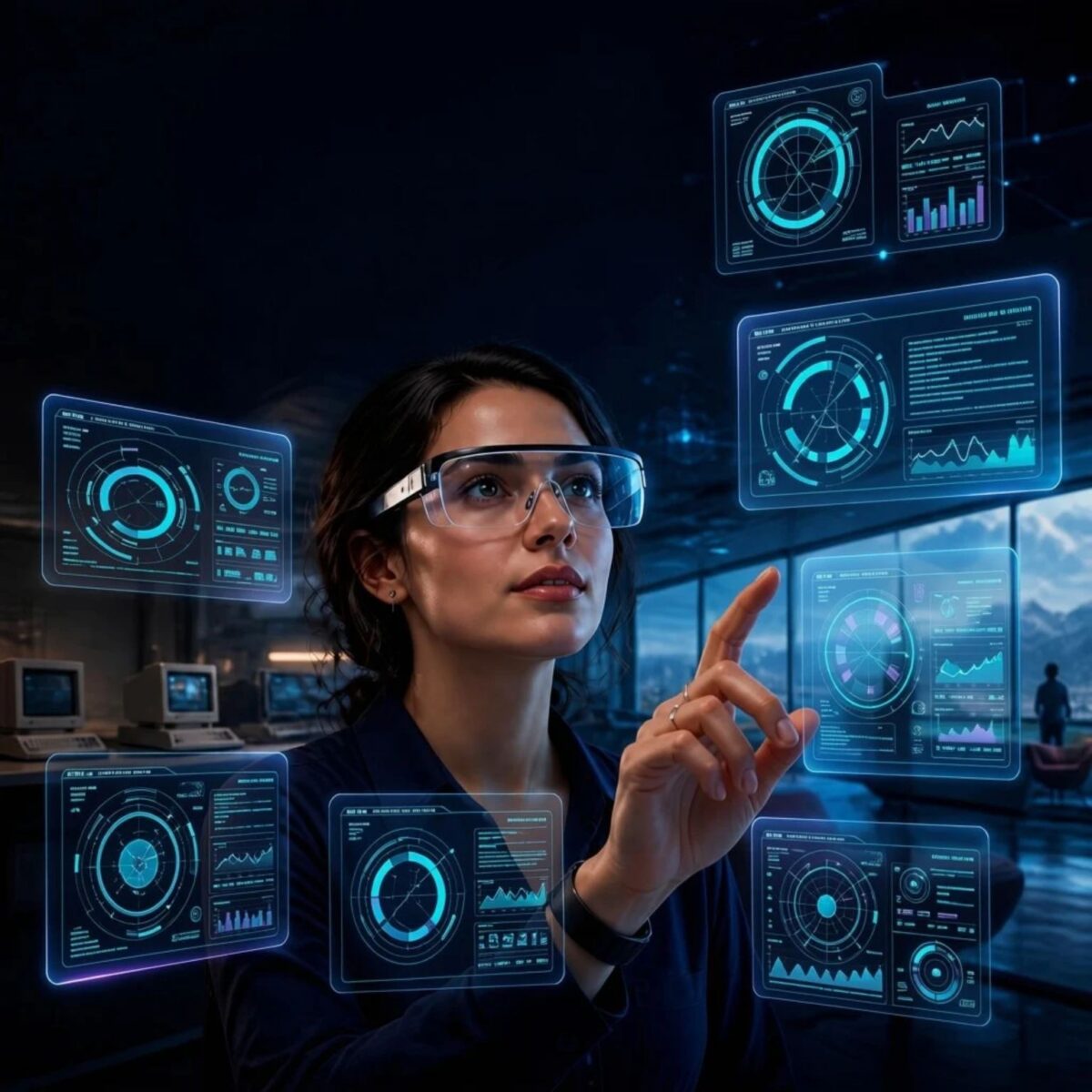
Smart glasses, spatial computing, interfaces on the skin or implants: I compare several visions of the future of computing. Between enthusiasm, personal preferences and reservations about cost, uses and everyone's freedom, I consider the place these interfaces could take in our everyday lives in the 2030s.
So, what will the way we use computing look like in five or ten years? Will we still have a computer, a phone, several screens, a keyboard and a mouse? Or could some of all that fit into a pair of glasses, with an artificial intelligence we can speak to directly?
That is the question I asked myself when I came across a demonstration by Mark Zuckerberg. I did not study the whole presentation straight away. What interests me here is not reciting a specification sheet to you: it is comparing several visions of the future of computing and what they could change in our everyday lives.
I use OpenAI’s tools every day, I take an interest in computing projects, and a recent OpenAI presentation had also caught my attention. But I have not tested every AI or all these interfaces. My enthusiasm, preferences and questions therefore do not amount to a comparative product test.
From the phone in your pocket to the computer in front of your eyes
Just think how far we have come from a computer twenty or twenty-five years ago to the phone you use today. We watch videos, communicate, work on documents and access services from a device that fits in our hand. I am not claiming to make a comparison of processing power that holds true for every device and every use. I am talking about this very tangible shift in the place computing occupies in our lives.
With that in mind, I think it is reasonable to ask what might fit into glasses in the future. Not just more processing power: a different way of displaying information and controlling it. When I talk about five or ten years, I mean a timeframe for reflection, not a guaranteed delivery date.
To keep things simple, I distinguish four avenues: the implants associated with Neuralink’s research, interfaces worn on the skin, the smart glasses promoted by Meta, and Apple’s spatial computing. They are not all at the same stage, and they do not meet exactly the same needs. That is precisely what makes the comparison interesting.
Neuralink: medical hope is not the same as a computing accessory
I will start with Elon Musk, because my view of his projects has changed. Tesla, SpaceX, launches and satellites being put into orbit had impressed me. Then I distanced myself, particularly because of military activities that do not align with my values. SpaceX’s defence contracts are not just a rumour: examples can be found in announcements by the Space Development Agency. My disagreement with that direction, however, remains a personal judgement.
I do not use X, Grok or xAI’s tools. I was never keen on Twitter either. I remain critical of what I perceive as tolerance of extremist or conspiracy-based discourse, and of a conception of freedom of speech that would justify anything: to me, that freedom must not become an excuse to ignore the law. I can recognise technological merit without endorsing the choices of the person behind it.
With Neuralink, the avenue that interests me is an interface between the brain and an external device. The PRIME study documentation describes research intended, among other things, to enable people with paralysis to control devices such as a computer. It presents an experimental implant and system, with an assessment of their safety and functioning.
I am not entirely opposed to this research. If it can help people facing a significant disability, I understand the hope it represents. However, helping someone control a computer is not equivalent to curing a disease that is currently incurable. For now, a medical prospect cannot be turned into a promise of a cure.
And, for me, there is a major difference between this research and the idea of having a chip implanted to make using software easier. My questions remain about choice, intervention in the body and the legal framework. In the United States, the FDA distinguishes the framework for clinical investigations from that for marketed devices. So the issue cannot be reduced to “implants are legal” or “implants are illegal” without specifying the device, its use and the country.
Interfaces on the skin: another way to control devices
Another avenue appeals to me more for everyday use: an interface worn on the skin, for example on the forearm, to scroll through information or control a device. I associate this idea with Bill Gates’s vision. That personal attribution is not sufficiently substantiated to be presented as a fact.
There is, however, documented work such as DuoSkin, developed at the MIT Media Lab with Microsoft Research. These are temporary interfaces applied to the skin, capable, among other things, of receiving touch input or communicating information. This is not a conventional permanent tattoo, and it does not prove that a universal device can already control every screen in the home.
What I like about this direction is the idea of changing the relationship between person and machine without necessarily using an implant. Imagine gesture or touch controls combined with voice: we would no longer automatically reach for a keyboard, mouse or remote control. But choosing an electronic tattoo would still be a personal decision. Not everyone wants to wear an interface on their body, even temporarily.
Meta’s glasses: the vision I find most promising for everyday life
The demonstration I am referring to left me above all with an impression: seeing computing move in front of the user’s eyes. What I remembered was Mark Zuckerberg backstage, interfaces associated with AI, and preparations for his appearance on stage, including a voice command for music given to his Meta glasses. I am describing what I took away from it, not a list of features I personally verified on a particular model.
Several things need to be distinguished: glasses with a voice assistant, glasses with a display, and an augmented reality experience that can position elements in space. These expressions are not interchangeable. In its September 2025 presentation of Meta Ray-Ban Display, Meta describes, among other things, a display for brief interactions and a wristband that turns muscle signals into commands. That does not mean every pair of the brand’s glasses already replaces a complete computer.
The Connect 2026 announcements continue in this direction by bringing AI agents and wearable devices closer together. But an announcement, a demonstration and a feature actually available in a given configuration remain three different things. This distinction matters if my interpretation of the future is not to be mistaken for a universal capability already on the market.
In practical terms, fewer steps between an idea and an action
Imagine asking for music to start and having it play on the device you want. Or dictating a message, looking up information or asking an AI to do something without constantly switching between phone and computer. Some voice interactions already exist in compatible environments. What interests me is the possibility of making them easier to combine and more accessible to ordinary people.
Today, I still find many of these steps unnatural: copying text, pasting it elsewhere, changing windows, picking up the phone again, typing with a keyboard or an on-screen keyboard, or using voice dictation, depending on the features available. From my study of Meta’s well-designed glasses, I think that, combined with useful AI, they could make some of these steps easier. That would be interesting both for communication and for certain computing, marketing or professional activities.
This is what could be called a form of dematerialisation of computing. I do not mean that hardware disappears: devices and resources are still needed to calculate and display things. Rather, I imagine that we could have fewer physical screens to buy and find some of their uses in a visual interface we wear. Seeing several windows does not mean owning several independent computers, but the experience could come close for certain tasks.
Of course, the business model matters. How much will the glasses cost for the way we use them, with an entry-level price of $249? Which services will be included? Will advanced uses require subscriptions or additional credits? I imagine affordable offerings for everyday life, but without looking into them, neither their promised availability nor their prices are detailed. The resources of these groups, whether Neuralink, the technologies associated with tattoos as I relate them to Bill Gates, Apple Vision or Meta’s glasses, make it possible to explore possibilities still far removed from the general public’s everyday life in 2026. A spectacular presentation alone does not answer the question of what we can afford, even if the demonstrations are astonishing after 10 years of research and development.
Apple Vision Pro: spatial computing, with a substantial budget
The other vision that interests me is Apple’s. I am more of a PC person than a Mac person, which explains why the names and products in that world sometimes come to me less readily. To get the names straight: Apple announced Tim Cook’s move to executive chairman and John Ternus’s appointment as chief executive from 1 September 2026 in its statement on the transition.
With Apple Vision Pro, we are talking about a product already on sale that allows users, among other things, to watch content and organise applications in a visual space around them. This is what Apple calls spatial computing. What interests me is the possibility of no longer confining the entire experience to a screen on a desk.
In one example, I imagine an empty piece of furniture on which we could make a virtual vase appear. The image is easy to grasp: visually adding a digital object to the surroundings. However, I am not presenting the creation of any object through a simple sentence as a guaranteed headset feature. That depends on the applications and what they actually allow us to do.
To me, the price remains a serious obstacle: as far as I know, €5,000 for this augmented reality headset. To give a precise reference rather than an approximate figure, Apple announced the Vision Pro M5 from €3,699 in France on 15 October 2025. That is an announced price for that version on that date, not a quotation valid for every configuration when you read these lines.
At that price, I still see it as something reserved for an elite, not ordinary people. I hope technological progress will make these experiences more affordable. But costs do not fall automatically, and I do not know how quickly or in what form this possible wider accessibility might develop.
My personal ranking: practical use before astonishing results
If I rank these approaches according to my interest in everyday life, rather than a scientific test or a performance comparison, I still put them in this order:
- The glasses promoted by Meta. Their form seems promising to me as a way of making certain interactions more natural. However, my interest depends on actual use, the total price and any associated services, which seem affordable and suited to everyday life.
- Apple Vision Pro and Apple’s spatial approach. I find the vision interesting, but the budget remains a significant barrier.
- Interfaces worn on the skin. They interest me as another way of controlling devices, subject to their maturity and each person’s choice.
For me, implants are a separate case: I do not put them on the same level as a device we buy to work or watch a film. My interest in their medical possibilities does not remove my reservations about transforming the body for everyday computing use, a form of cybernetic transformation of the human body.
And preferring the form of Meta’s glasses today does not mean I prefer its AI to OpenAI’s, because I am unfamiliar with it, although I have heard of the Muse project, an apparently free AI assistant. I have not studied or tested Meta AI sufficiently to make that comparison. For now, I am sticking with the OpenAI tools I use every day. The scale of adoption also matters to me, although I am not citing a verifiable figure here. The interface that appeals to me and the service I use are two separate questions.
Minority Report: a cinematic image that helps us imagine these interfaces
When I think of gestures controlling images, I come back to Minority Report, Steven Spielberg’s film with Tom Cruise, released in 2002. Do you remember those sequences where the character manipulates information on a large screen with his hands? It is a visual comparison that makes immediate sense.
In this film, visions of future crimes belong to fiction, with the “precogs” able to transmit images of visions of crimes in the near future that need to be prevented. These are not evidence of what our technologies can do today. But the way images are moved, brought closer and examined gives a very concrete representation of an interface different from a keyboard and mouse.
I recommend the film without telling you what happens next. To me, Spielberg is a master of cinema: the screenplay, effects, dialogue and music all contribute to this impression of a completely wild future, yet one realistic enough for us to picture. This admiration is, of course, my personal opinion.
Google Glass: a good idea is not enough to establish a use
The idea of computing glasses did not begin with recent presentations. Google was already pursuing this direction with Glass. To establish the dates: the project’s official history places public trials in 2012 and the Explorer programme in 2013, before a shift towards professional uses. These are the dates to remember rather than the years I mentioned from memory in my live broadcast.
What I take from this is that impressive technology does not automatically become an everyday object. When few people use it and interactions remain limited, its appeal remains low. That is not the sole explanation for the history of Google Glass; it is the point that interests me in my reflections on the adoption and wider accessibility of new technologies.
A pair of glasses needs to find its place in everyday uses. In my view, AI helps make these interactions more useful and easier. But I will not present recognising everyone we encounter, or automatically exchanging contact details by mutual agreement simply by passing people with compatible devices, as established features. The example of exchanging email addresses with mutual consent remains, for me, an idea for an interaction, not a product specification.
New freedoms, provided we retain the choice
Ultimately, I am not interested only in processing power or spectacular effects. I am interested in what could become more accessible. If someone can use their voice and a few gestures to achieve a result that previously required several steps and advanced skills, I think that is worth exploring. This question connects with my thoughts on the changing role of the software developer.
But everyone must be able to choose their degree of involvement. Wearing glasses, wearing an interface on the skin and agreeing to a medical procedure are not equivalent decisions. My intuition is that glasses will find their place in everyday life more easily. That is a preference about use, not a verdict claiming that one technology must be more legal than another, as these technologies are strictly regulated by various laws.
Questions of security and freedom must not disappear behind marketing demonstrations: what are we sending to the service we use, what are we giving access to, and which features depend on a subscription? These are subjects to investigate before buying and points to check before confusing an appealing possibility with a solution suited to our own lives.
To sum up: fewer physical screens, perhaps, but still personal choices
My vision of the future of computing remains fairly optimistic. I think augmented reality, wearable interfaces and AI could profoundly change the way we communicate, work and entertain ourselves. I can imagine fewer physical screens for certain uses and a more direct relationship with computing services, as envisaged by Apple’s spatial computing. I am not saying that all current devices will disappear or that everyone will adopt the same solution or protocol.
The glasses presented by Mark Zuckerberg seem particularly promising to me and, in my view, this direction will eventually find its place. I simply want to hold on to both my enthusiasm and the questions that remain open: cost, actual features, permitted uses and everyone’s freedom. You will find more reflections in my collection of articles on artificial intelligence.
You might ask yourself which interface would feel natural to you in the future: a pair of glasses, a headset, a control worn on the skin, or simply your keyboard and mouse, with implants remaining within the medical sphere. You could also consider what would make you want to change and what you would absolutely want to keep.
José DUTIAN