What are the real, the virtual, and virtual reality? An exploration across science, philosophy, and spirituality to seek truth in the age of screens and AI.
nn
Reality, Virtuality, Virtual Reality: Seeking Truth to Live Better
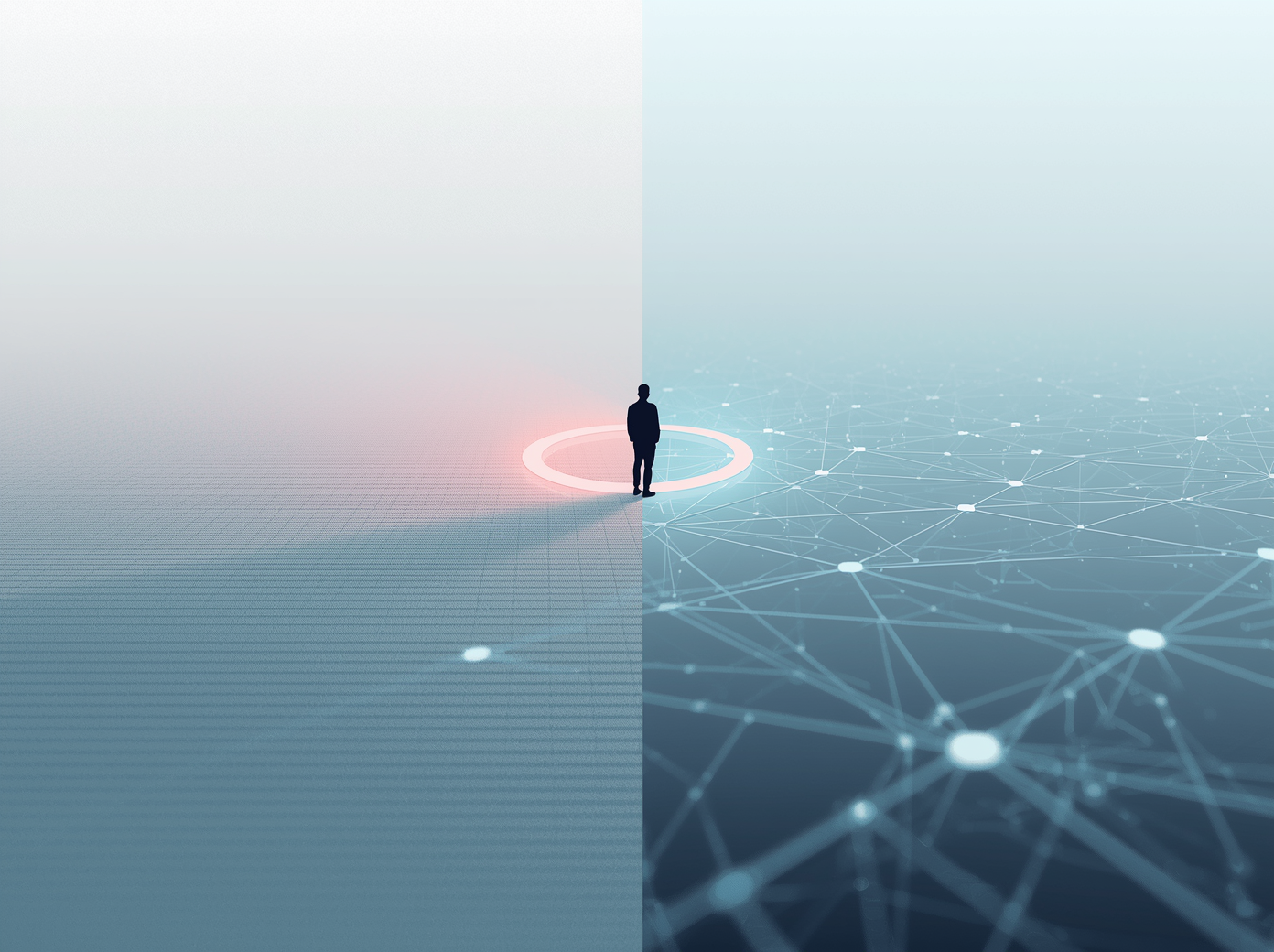
There is an idea that seems essential to me if we want to move toward a form of happiness in life: seeking truth. Not necessarily a fixed, closed, definitive truth, but a truth we approach gradually—through reflection, experience, observation, and the awareness we develop. In this article, I want to explore a topic that I find as fascinating as it is fundamental: what is reality? what is the virtual? and what is virtual reality? Behind these words, there is not only a technological question. There is a philosophical, human, and also spiritual question. It is also a very current question, at a time when artificial intelligence, screens, avatars, simulations, and digital worlds take up more and more space in our lives. I do not claim to provide an absolute answer. On the contrary, the more I think about it, the more I tell myself that truth may be a blend of several approaches. Perhaps it is not a single theory that explains everything, but a set of perspectives that, when brought together, help us better understand what we live through.Reality: what is material, what exists, what obeys laws
To begin simply, I would say that reality is first and foremost what is material. It is what exists concretely—what we can touch, see, perceive, measure. But it is not only matter in the strict sense. Reality is also the natural laws that govern our universe. We can speak of universal laws: time, space, causes and consequences, natural rhythms, physical limits, the living world’s balances. All of that is part of reality. When we talk about the dimensions of our world, we spontaneously think of length, width, and depth. Yet we then learn that the fourth dimension is time. We therefore live in a universe where the real is not made only of material objects, but also of an invisible framework that structures everything: space-time. In other words, reality is, at once:- matter,
- phenomena,
- natural laws,
- time passing,
- and the overall order in which our existence takes place.
Virtuality: ideas, projections, simulations, designs
Facing this reality, there is virtuality. The virtual is not necessarily something false. It is not necessarily an illusion in a simplistic sense. Rather, the virtual is what belongs to thought, projection, simulation, design. It is what can exist in the mind, in a system, in a representation—without existing materially in the same way as a physical object. Virtuality can include:- ideas,
- thoughts,
- imagined scenarios,
- models,
- computer simulations,
- digitally designed worlds,
- and more broadly everything that is represented without being directly material.
An increasingly blurred boundary between the real and the virtual
It is interesting to note that, in everyday life, the real and the virtual already intertwine constantly. Let’s take a simple example: money. We can still pay with cash. We can pay with a check, on paper. There is then something very material in the act: a bill, a coin, a signature, a physical medium. But we can also pay with a bank card, then contactless, sometimes almost without doing anything other than bringing an object close to a terminal. The payment takes place, the item purchased is real, the groceries are in the bag—and yet the exchange passes through increasingly abstract, increasingly dematerialized layers. So where is reality in all of this? In the item purchased? In the money exchanged? In the banking system? In the numbers that circulate? In the collective trust that gives value to the transaction? I find this question very interesting because it shows that the virtual is not necessarily separate from the real. It can be an intermediary. It can be a language. It can be an extension of the real. It can even sometimes become the dominant form through which we access very concrete effects in the material world. We could make the same observation with digital currencies, book money, bank accounts, accounting entries, or even the financial flows that directly influence our lives while remaining, in their operation, largely invisible.Happiness, truth, and respect for universal laws
In my view, the search for happiness goes through the search for truth. And that search implies looking for what is stable, what is right, what is coherent with the laws that structure our existence. I am speaking here of what we can call, in a general way, universal laws: natural laws, fundamental principles, the balances that govern life and the world. Many schools of thought, philosophical traditions, and spiritual currents converge on this idea: we must learn to live in accordance with an order greater than ourselves. And the further we move away from it, the more disorder we create within ourselves and around us. This is why the question of truth is not only intellectual. It is also existential. It engages the way we think, act, speak, choose, transmit—within a search for happiness.Virtual reality: immersion between perception and simulation
Virtual reality represents something else again. It is a form of immersion into a simulated universe, made perceptible through technical tools: headsets, glasses, interfaces, interactive digital environments. We are not yet at it completely on a large scale, even if major companies have been investing in the field for a long time. In my view, important limits still exist: the cost of equipment, unequal access to technologies, persistent poverty in many societies, including in Europe or the United States. It is therefore likely that, at first, advanced virtual reality will remain reserved for a minority. Then, as often happens with technologies, it could become more widespread in ten, twenty, or twenty-five years. We can already imagine very advanced future uses. For example, in a movie theater, instead of everyone watching exactly the same film, each person could wear a headset or immersive device and live a personalized version of the work—adapted to their profile, tastes, digital habits, and even to their history on social networks or in artificial-intelligence systems. In other words, the perceived image could become entirely personalized. The content itself would become dynamic, individualized. This would open immense possibilities, but also considerable questions about freedom, identity, influence, and manipulation.Artificial intelligence: a productivity tool, a simulation machine, a challenge for consciousness
Today, artificial intelligence seems to me above all to be a productivity tool and a tool to support thinking. It allows us to produce faster, get ideas, structure reasoning, generate text, images, videos. All of this belongs to virtuality: these are digital productions, designed on a screen, by computation, from models. But the more these tools progress, the more a difficulty appears: how do we distinguish what is authentic from what is simulated? If someone speaks live, we should be able to certify that they are real. But already, that is no longer as obvious as it used to be. We can imagine avatars, synthetic voices, generated faces, digital characters capable of imitating a real person—their appearance, tone, ideas, or even ideas they never had. This raises a major problem:- identity,
- authentication,
- responsibility,
- and even consciousness.
Singularity and the growing confusion between the real world and the simulated world
There is also an idea that often returns in reflections on the technological future: the singularity. Without going into excessive technical detail, we can understand it as a moment when artificial intelligence and technological systems would reach such a level that transformations would become extremely rapid and difficult to anticipate. In that perspective, the distinction between what we see on screens and what we live in our everyday reality could become increasingly difficult to establish—not necessarily because everything would be false, but because simulation could become almost indistinguishable from direct experience. This hypothesis touches the limits of our consciousness. How far are we able to discern? How far can we remain lucid? From what point does perception become manipulable enough to redefine our relationship to the real?Simulation theory: what if our reality were itself simulated?
Among the most famous theories is simulation theory. It consists in asking whether our reality itself might not be a form of simulation. It is an idea found in science fiction, in some films, in certain philosophical or scientific speculations. According to this view, our world could be an advanced simulation—designed by a higher intelligence, a very advanced civilization, or a system that completely surpasses us. Personally, I find this theory bold, sometimes excessive, but interesting to examine. It forces us to ask fundamental questions:- how do we know that what we perceive is not an illusion?
- what distinguishes a physical reality from a simulated reality, if both produce coherent effects?
- is our experience enough to prove the ultimate status of the world we inhabit?
Descartes: the separation between matter and thought
Long before computing, other thinkers had already laid the foundations of this reflection. René Descartes, for example, profoundly marked this question by distinguishing what belongs to matter from what belongs to thought. With him, we understand that the real is not reduced to what we can touch. There is also the thinking subject, consciousness, the very act of doubting, questioning, reflecting. His best-known formula, “I think, therefore I am,” summarizes this intuition: thought itself becomes proof of existence. I find this approach extremely powerful. It reminds us that even before solving the world’s enigmas, there is already something essential: the presence of a consciousness that questions. The very fact of seeking truth already indicates something fundamental about our condition.Another theory: thought influences our reality
There is also a view according to which our brain, our thought, our way of interpreting the world directly influence our reality. Here, it is no longer only a matter of separating matter and thought, but of saying that our thinking acts on the way we live the real, understand it, and sometimes even orient it. Our beliefs, choices, fears, hopes, decisions, and mental habits shape our future. That does not mean everything depends on us in a magical way. But it does mean that our inner life has real weight. What we cultivate within has concrete consequences in our lives and relationships. This is also an important idea when we think about peace and war. Conflicts are born first in human minds. And if we want to achieve peace, we must begin by planting seeds of peace in consciousness.Quantum physics: a reality more complex than it seems
Another path of reflection comes from quantum physics, which fascinates because it seems to challenge our ordinary intuition of the real. At that level, reality no longer resembles what we perceive at the human scale. A particle can be described in relational, probabilistic, sometimes counterintuitive ways. Some interpretations suggest that a thing’s state can be understood only as a function of a set of relations or observations. This opens the door to troubling ideas: superpositions, multiple states, parallel realities in certain interpretations, the coexistence of possibilities before they become actual. All of this becomes very complex to grasp fully, especially without deep scientific training. But even at a modest level, it leads us to an important conclusion: reality may be far more subtle and far more mysterious than what our immediate perception lets us believe. And if that is true, then each of our thoughts, each of our words, each of our actions carries even more weight. Because our future is built from a chain of causes, choices, traces left by our past, and directions given to our present.Spirituality: consciousness, energy, unity
Finally, among all approaches, there is one that I find particularly strong: spirituality. I am not saying it fully replaces the others. On the contrary. I think it can encompass them, or at least complement them. Where some theories describe mechanisms, spirituality seeks meaning, unity, an inner orientation. In this view, reality is not only matter. It is also:- consciousness,
- energy,
- connection,
- unity,
- a deep relationship between oneself and the universe.
Everyone lives in their own reality, and there are unalterable truths
The more I think about these topics, the more I feel that everyone lives in their own reality—with their history, perception, sensitivity, capacities, and beliefs. There also exist truths that are more stable, deeper, more universal, which we have the mission to seek, discover, and acquire. The difficulty is that we do not always know how far our freedom goes. Are we entirely free? Partly conditioned? Does our past program us? Is our future already written somewhere? Or do we truly build it—through our choices, efforts, awareness, and our capacity to learn and correct ourselves? I personally believe we have a real share of responsibility. And I also believe we must know how to forgive ourselves for past mistakes in order to keep moving toward happiness.Conclusion: seeking within yourself the truth that elevates
Ultimately, this reflection on reality, the virtual, and virtual reality goes far beyond technique. It brings us back to a deeper question: how can we live authentically? In a world where simulations multiply, where screens become permanent mediators of our experience, where artificial intelligence can produce ever more convincing content, it becomes essential not to lose sight of what matters most:- what is authentic,
- what is right,
- what is coherent with the deep laws of life,
- and what leads us toward inner and collective peace.