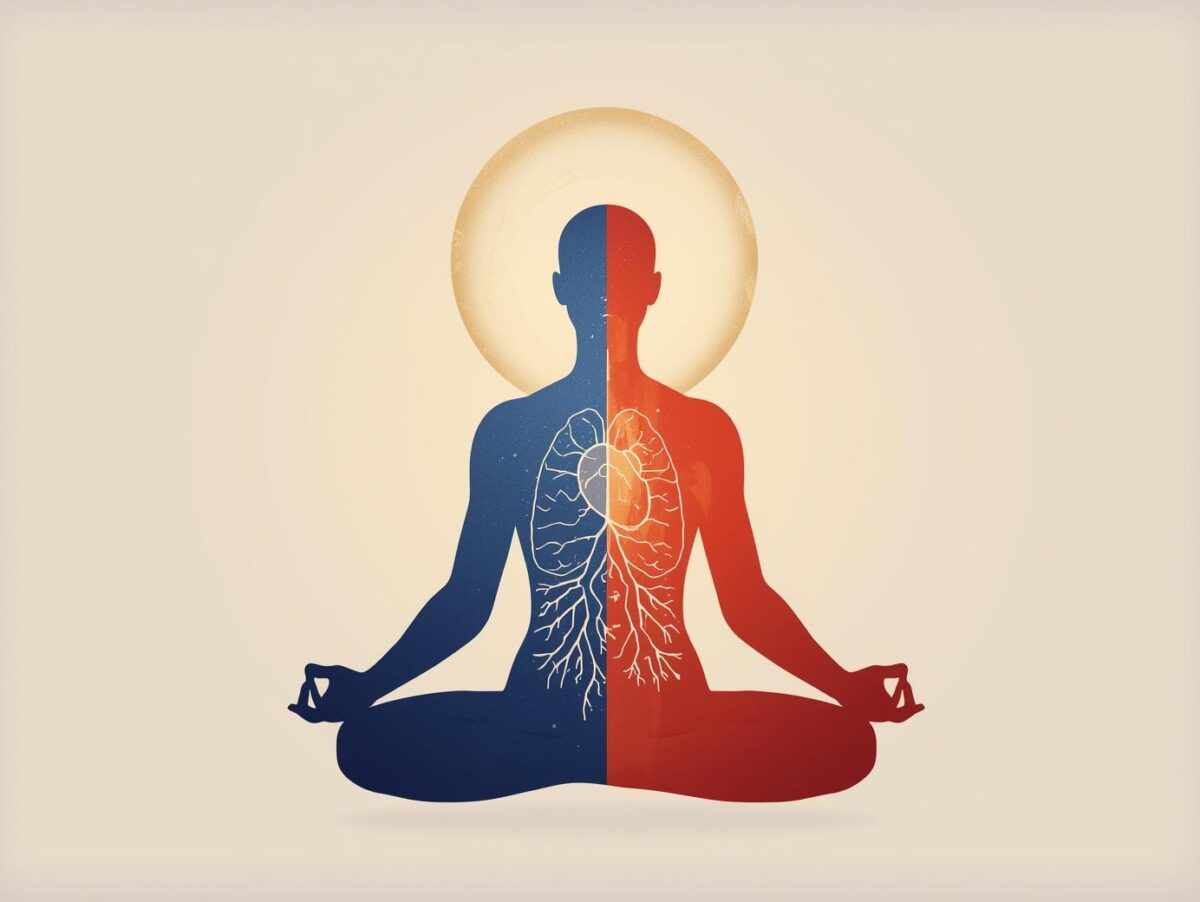
Being in balance with yourself is neither a magic formula nor superficial wellness. This article connects body, mind, neurodiversity, meaning in life, and self-confidence to explore a deeper and more lasting balance.
AI Mention: Article created by the author from recordings, structured by AI, reviewed and corrected by the author, then voiced by AI.
Being in balance with yourself is neither a magic formula nor superficial wellness. Personal balance grows from the relationship between the body, the mind, and the way we inhabit our lives.
This article connects information, neurodiversity, meaning in life, and self-confidence to explore how deeper balance emerges from inner coherence.
Defining Balance: From the Physical to the Mental
Let’s take a simple example: when we walk, we are balanced on our two feet.
That is an obvious form of physical balance.
But balance is not limited to the body. There is also mental balance.
It is a very old principle, often summarized by the idea of “a healthy mind in a healthy body.”
Ultimately, balance lies at the intersection of these two dimensions:
- Physical balance
- Mental balance
We often hear simplified messages on television: eat balanced meals and exercise.
Even if that sounds basic, nutrition does indeed play a central role in overall balance.
Nutrition and Personal Balance
Food can have several meanings when discussing balance.
Some foods are more nutritious than others and can either benefit us or harm us.
Naturally, for our health, we seek what benefits us rather than what harms us.
But we must also understand that each person is different: depending on physiology and metabolism, certain foods are better assimilated than others.
Finding balance therefore also means discovering what personally suits us — especially nutritionally.
Mental Balance: Information, Philosophies, and Fear
Mental balance works in a similar way.
Certain information, readings, philosophies, or cultures resonate with us more than others.
By searching seriously, we often find sources of inspiration, schools of thought, or philosophies that help us grow.
That is precisely their purpose.
Recently, for example, I joined a group discussing neurodiversity.
It is a complex subject, difficult to fully grasp, and resembles an evolution of modern psychology or psychiatry, aiming to better classify psychological profiles and adapt approaches accordingly.
But when we step back and observe our modern societies — films, media, television, horror movies, science fiction, action — we might ask ourselves whether, at some point, we are all psychologically affected.
Fear is everywhere.
And mental balance also involves the ability to confront that fear and develop self-confidence.
Self-Confidence and Clarity
Having self-confidence does not mean living in an unrealistic world while ignoring risks and problems.
It does not mean living in a bubble where “everything is fine.”
Life, both yesterday and today, confronts human beings with similar problems.
Ancient philosophers and mentors across different eras have all discussed comparable principles for approaching life constructively.
These principles concern:
- Health
- Family relationships
- Work
- Finances
- Self-knowledge
Studying, learning, understanding, communicating — all of this is important.
But at some point, action is necessary.
Action as a Reflection of Our Balance
Our actions are directly linked to our level of balance.
Being in balance with oneself ultimately means being in balance with one’s environment.
The situation we find ourselves in today is coherent with who we are — with the totality of our person.
We live in a complex and interconnected world.
Our words, for example, influence both ourselves and others, especially through social media.
Entertainment can be beneficial: laughter, inspiring music, cultural performances.
But there is also a strong tendency toward drama — in theater, opera, and media.
The challenge is to find balance between realism, clarity, and positive projection toward the future.
Accepting Difficulties in Order to Grow
Life includes negative dimensions that cannot be avoided.
We must learn to live with them, face obstacles, and transform negativity into growth.
Physically, this involves effort: exercise, nutrition, healthy habits.
Mentally, it involves study, reflection, and self-understanding.
Personal balance eventually radiates naturally into our environment.
A difficult concept to accept is this:
The life we are living today is the result of decisions made 15, 20, or 30 years ago.
Likewise, what we plant today will bear fruit in the future.
We often want everything immediately: love, health, adrenaline, balance, happiness.
But wanting is one thing — acting coherently is another.
Desire, Happiness, and Perseverance
Life is made of obstacles.
Progress necessarily requires overcoming them.
Whether becoming physically stronger or mentally more stable, one must deeply desire change — and then act accordingly.
We are often overwhelmed:
- By social media
- By work
- By family
- By relationships
- By obligations
Finding balance also means finding a path, meaning, a way to thrive.
Living without desire is a position defended by certain philosophical schools, but it is not mine.
Nor do I advocate pursuing pleasure at all costs.
I believe more in:
- A level of satisfaction
- A level of recognition
- And above all, a level of happiness
Happiness is not an abstract concept.
It is the ability to overcome obstacles, to possess the vital energy required, and to act coherently in the face of problems.
The greater the desire, the greater the effort required.
Problems, Opportunities, and Achievement
The problems we face are not random.
They are often the precise obstacles we must overcome to move toward what we truly desire.
Opportunities function the same way.
An opportunity is not something easy or free — it is the result of work, repeated effort, sometimes over the long term.
Whether professional projects, communities, content creation, or paid activities, everything requires investment — time, energy, and sometimes money.
A person’s financial level often reflects their level of balance between themselves and the market.
Potential exists everywhere.
What is most often lacking is not ability, but the willingness to confront one’s own difficulties instead of avoiding them.
Finding Your Personal Balance
The balances we experience today are our balances.
Even when they seem negative — poor health, financial difficulties, discomfort — they represent a form of balance we have found to cope with our reality.
Some individuals overcome their fears and achieve extraordinary results through strong mental resilience.
Balance is built daily.
It involves balance with oneself, but also balance with others — through helping, sharing, and transmitting knowledge.
José D.
Reference: Balance yourself
Reference: social media
Reference: information technology
Reference: artificial intelligence