Artificial intelligence is changing education, culture, social relationships and the future of young people. A reflection on learning, critical thinking and relationships.
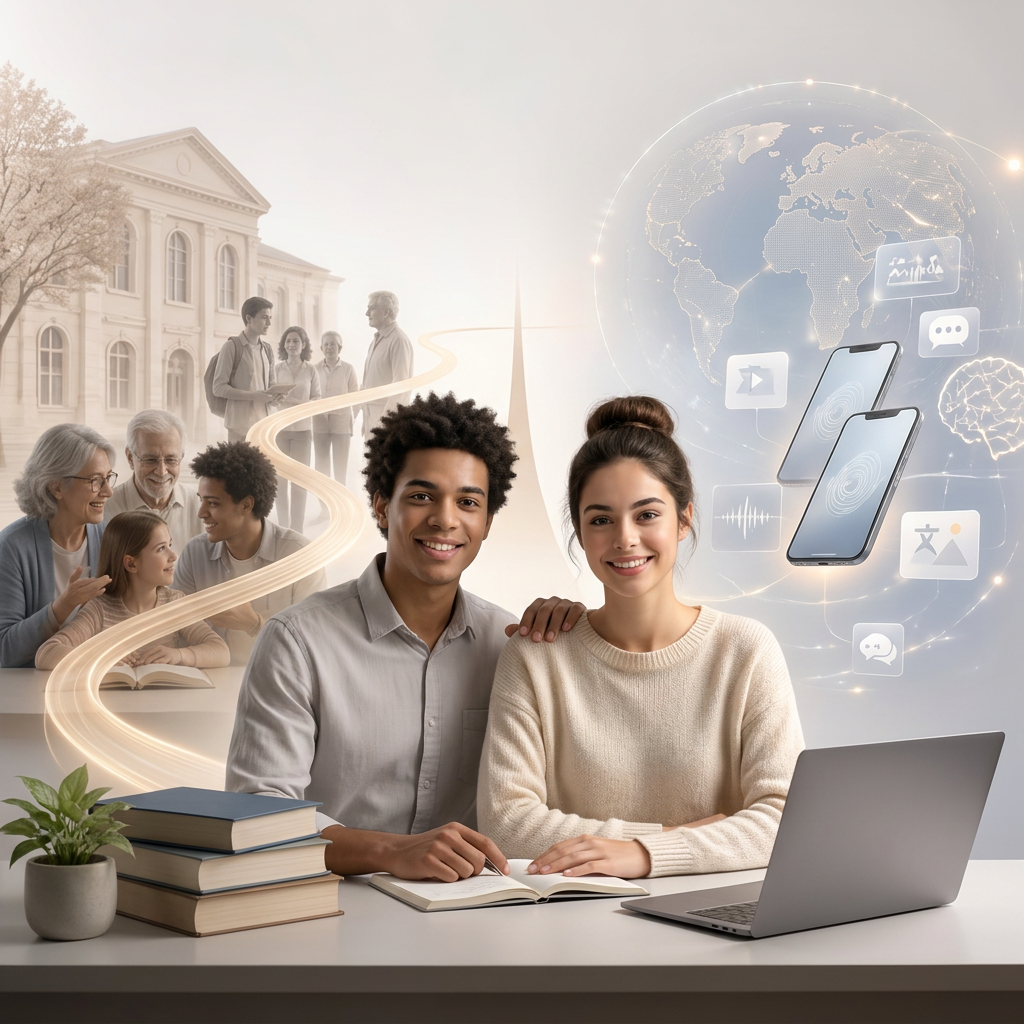
So what is the future of young people in the age of artificial intelligence and social media, in a world where everything is moving faster and faster, and where we sometimes feel that we no longer really have the time to learn, build skills or simply think calmly about our future?
I am talking about youth in the broad sense: teenagers, of course, but also young adults who reach a point in life where they need to become independent, find their path and think about what they truly want to build.
How many people have I spoken to who say they want to believe in something, but do not know what? Who want to make choices, but do not really know which ones?
I think artificial intelligence makes this question even more interesting, because it is changing the way we learn, our access to knowledge, our culture and even part of our social relationships.
Everything Starts With Education
At the beginning, when we start our education, we usually have a teacher.
But education obviously goes far beyond school.
There is the education we receive from our parents. There is school education. And then there is the whole social side of education: the way we learn to live with others, communicate, understand the rules of a society, develop our knowledge and gradually become more autonomous.
So I think that in the age of artificial intelligence, there are many questions to ask about how learning is evolving.
When I talk about youth, I think of that period when a person begins to wonder what they want to do with their life, if everything has not already been decided beforehand.
Having a roof over your head. Having enough to eat. Being able to work. Having friends. Possibly building a romantic and family life. Finding balance. Quite simply, trying to live happily.
There is obviously not one valid path for everyone.
And that is precisely where education should play its role.
Can Artificial Intelligence Become a Teacher?
Today, behind a simple phone, you can already access an artificial intelligence capable of explaining many things.
Depending on the services used, the models available and the budget you want to invest, you can obtain answers that are more or less long, developed and adapted to the question being asked.
You can ask:
“Explain this concept to me.”
“Give me examples.”
“Help me practise this subject.”
“Explain it differently because I have not understood.”
“Give me synonyms for this concept.”
“Help me structure this idea.”
So, in concrete terms, artificial intelligence can already fulfil part of the role of a private tutor.
That does not mean, in my view, that it should replace school or teachers.
The real question is how these tools can complement learning.
Because, in the end, what is education?
For me, it means enabling someone to learn progressively, develop skills and then flourish in their life.
The aim is not necessarily to turn every pupil into some kind of high-performance machine destined to revolutionise the planet.
Everyone can have their own goals.
Learning in a World Full of Distractions
There is also another problem: the omnipresence of screens.
Phones, computers, social media, television, short videos, content that follows one piece after another according to our tastes or according to what algorithms think is likely to hold our attention.
It is true that we can quickly spend a huge amount of time behind a phone, a computer or even an artificial intelligence.
And during that time, do we still take enough time for ourselves, our family, our friends and simply to talk with people?
How many people walk down the street today with their eyes fixed on their phone?
How many would be able to slow down, stop and simply have a conversation with someone?
How many people are still open to the possibility of a meeting or an enriching exchange close to where they live?
It is worth asking the question.
I do not think we should reject new technologies. I use them a great deal myself.
But we probably need to find a balance.
Should School Evolve With Artificial Intelligence?
Fifteen or twenty years ago, people were already imagining classrooms filled with large screens, computers and technologies capable of completely transforming teaching.
I do not know exactly how things work today in every school. I do not even know precisely what the rules are about phones in all schools.
But the question of attention necessarily exists.
If a pupil can watch short videos during a lesson, chat online or immediately ask an artificial intelligence for an answer, the relationship between the pupil, the teacher and knowledge changes.
And then there is also the question of respect for the person teaching, and above all the meaning of what we learn.
Personally, I did not succeed in higher education as I would have liked.
I sometimes felt overwhelmed by courses that followed one after another without always understanding the overall coherence.
Some assessments also seemed difficult to understand.
I remember, for example, my driving theory test, which I took in 1999. At the time, you had to get at least 35 correct answers out of 40. I got 36, although I thought I had done better.
At secondary school too, a few months before the baccalaureate, I had set myself the goal of becoming extremely serious and aiming for the highest distinction. In the end, I obtained a good distinction.
Why tell this story?
Because I think we need to be careful about the way we assess a person’s value only through school results.
School Level and Judgements Between Generations
We regularly hear that the level of the baccalaureate has declined over the decades.
Perhaps some exams were indeed more difficult in other periods.
But does that mean later generations have no value or no knowledge?
I do not think so.
The people who make this kind of judgement generally know neither the history, nor the difficulties, nor the individual path of the people they are evaluating.
Every era has its own difficulties.
And the aim of education should precisely be to help someone progress from their own level, not to explain to them that they are incapable because they do not match a previous generation.
We need to be able to find priorities, organize ourselves, acquire knowledge progressively and understand why we are learning something.
Otherwise, we simply end up overwhelmed by an accumulation of all kinds of knowledge that we are supposed to master.
The Paradox of Professional Experience
I found a fairly similar contradiction when I started looking for work.
A beginner could be asked to already have two years of experience.
Just imagine the contradiction.
To gain experience, you have to start somewhere. But to start, you are sometimes asked to already have experience.
And changing jobs can also mean changing city.
Before even receiving your first salary, you may then have to finance a move, housing, transport and various expenses.
So you already need savings in order to seize certain opportunities.
That is also why I am very interested in remote work.
Today we have all the technical tools needed to work remotely in many professions. Yet in 2026, remote work is still not systematically accepted or generalised.
At the same time, we are using more and more digital services and artificial intelligences that sometimes come from companies located thousands of kilometres away.
There is something interesting to observe in that contradiction.
After Google and Social Media, Artificial Intelligence
Several decades ago, the Internet was slower, less accessible and far fewer people were connected.
Then search engines such as Google completely transformed our access to information.
Then social media arrived.
Some companies from the history of computing and the Internet eventually influenced hundreds of millions, even billions, of people.
Today, a new stage is being built with artificial intelligence.
I think those who create the algorithms capable of selecting information according to users’ cultures, habits and tastes inevitably influence the way we see the world.
And artificial intelligence is now becoming part of all this.
It analyses, translates, recommends, generates, corrects and helps connect people even further.
That is why I consider artificial intelligence to be a real revolution.
A Phone Can Now Open Us Up to Other Cultures
Today, a simple phone can serve as a translator.
You can meet someone whose language you do not speak and still manage to exchange a few sentences thanks to your smartphone.
Thirty or fifty years ago, that kind of situation would have been much more complicated.
Travel was less accessible to part of the population, and the Internet did not yet exist in its current form.
Today, even with a limited connection, access to new technologies gradually makes it possible to reach more knowledge, cultures and information.
But where there is information, there is also disinformation.
And here again, we need to learn how to sort through it.
Information, Media and Personal Balance
I think we should also reflect on our media consumption.
How many scandals do we learn about every week?
How many documentaries, videos and pieces of information are built around what shocks, worries or provokes an immediate reaction?
I am not saying we should cut ourselves off from the world.
Some information is important and corresponds to realities we need to know.
But we can also ask ourselves a very simple question:
Will this information really help me in my own life?
Am I directly concerned?
Can I have any influence on this problem?
Is it really useful to spend an evening discussing the latest scandal everyone is talking about?
Unfortunately, there will always be scandals.
In my view, there are also many interesting, constructive or educational things the media could talk about more often.
We now have access to an almost infinite amount of content.
The difficulty, therefore, is choosing.
Finding a Balance Between Distraction and Learning
This is probably one of the major questions for young people.
We need to find a balance between time spent on distraction and time spent learning.
Because youth builds the future.
But it also learns and “unlearns”.
It receives information and disinformation.
It receives culture, advertising, opinions, algorithmic recommendations and now content created by artificial intelligence.
So we need to learn how to select what truly helps us progress.
Artificial Intelligence Will Also Transform Cultural Creation
Another area that interests me a great deal is creation.
We now see systems capable of generating images, music, videos and, gradually, films or documentaries.
For now, some demonstrations sometimes seem to me to seek spectacle or hyperrealism at the expense of meaning.
But I think the potential is enormous.
When these technologies are used by people who have both cinematographic knowledge and a real creative intention, they can become extremely interesting tools.
Because a film is not simply a few generated images.
You have to think about the script, the music, the dialogue, the rhythm, the rendering and the overall coherence.
If you simply ask an artificial intelligence to produce a script without any particular reflection, you risk obtaining something very generic.
A good screenwriter has experience and culture.
And that is where the past, present and future meet.
We probably will not build tomorrow’s culture by completely forgetting yesterday’s.
Towards a Decentralisation of Culture?
I also think there could be a real decentralisation of cultural creation.
People who would never have had the means to produce a documentary or certain audiovisual content will gradually be able to do so.
It can also help preserve more memories and pass something on to future generations.
But we still need to remain faithful to what we really think, to our story and to the values we want to transmit.
Technology is only a tool.
Then we need to know what to do with it.
And even when we create an excellent documentary, an excellent film or an excellent product, another question remains: how do we make it known?
That is where marketing and relationships remain important.
Creating something does not automatically mean someone will watch it or buy it.
Can All Social Relationships Be Automated?
We also hear a great deal about customer services fully automated by artificial intelligence.
From a technical point of view, this can be extremely effective.
An artificial intelligence could know your file precisely and answer your request immediately.
For a company, the objective seems obvious: offer an excellent experience and keep a satisfied customer.
But another question appears.
Does automating everything really allow us to keep a connection with reality and with others?
Sociability, open-mindedness, education and culture also pass through social relationships.
I am not saying it is bad to talk to an artificial intelligence.
On the contrary, I find these technologies extremely interesting.
I am simply saying that, in parallel, we must continue to develop a culture of social relationships.
The “Best Version of Yourself” Is Not Built in a Few Days
We also hear a great deal of talk about personal development.
We should never procrastinate.
We should immediately become the best version of ourselves.
I think we need to be careful with slogans.
Yes, we can evolve enormously.
In a few weeks or months, some efforts can already produce important changes.
And over five, ten or twenty years, a person can transform many things in their life.
But that generally requires organization, vision and consistency.
No one miraculously becomes the best version of themselves overnight.
And constantly setting unrealistic goals can produce exactly the opposite effect to the one desired.
We need to be able to progress at our own pace.
After Education Comes Culture
In the end, I always come back to the same idea.
Everything starts with education.
And after education comes culture.
But that culture is now evolving with artificial intelligence.
Personally, I see many positive aspects in artificial intelligence.
Of course it can make mistakes.
I have seen that myself.
But that does not mean the tool has no value.
We need to learn to understand its limits.
Not all models have the same capabilities. Results also depend on the model used, the question asked, the information available and sometimes the budget invested.
It is a bit like asking someone to perform a task they have never learned to do: you need to adapt what you ask to the capabilities available.
Image, text, video, audio: the results can be very different depending on the tools and the uses.
Culture Remains Essential to Use Artificial Intelligence Well
Perhaps this is precisely where culture becomes even more important.
Having an extremely powerful tool does not automatically mean knowing what to do with it.
You need ideas.
You need to know at least a little about the field in which you are working.
You need to be able to compare the results with something real.
And you need to keep enough critical thinking to recognise an error or a result with no real value.
Artificial intelligence can certainly help us become more cultured.
But culture also helps us use artificial intelligence better.
So the two can progress together.
What Kind of Youth for the Coming Decades?
I will stop on this idea.
I think artificial intelligence can positively influence education and culture in the years and decades to come.
I also hope that new generations will benefit from a more flexible organization of work, especially thanks to remote work and new technologies.
But every generation will have its own difficulties.
We can look at another generation and think it had an easier life.
I am not sure it is that simple.
Every era has its opportunities, constraints and problems.
And often, it is only ten or twenty years later that we can look back and ask ourselves:
Did I make the right choices?
Did I remain faithful to what I truly wanted to build?
Did the technologies I used help me become more cultured, more autonomous and more open to others?
For me, this is probably where one of the real questions of the future lies.
Artificial intelligence can save us a great deal of time and give us access to extraordinary knowledge.
But we still need to know what we want to do with the time and knowledge it helps us gain.
José DUTIAN